Multi-tenant AI voice platforms: how data isolation protects your customers' calls?
- 5 days ago
- 7 min read
Updated: 3 days ago
When multiple businesses run on the same AI voice infrastructure, a natural question arises: what happens to their data?
Here's how multi-tenant architecture works, where most platforms fall short, and what genuine isolation actually looks like in practice.
In this article
What "multi-tenant" actually means for AI voice
The word "multi-tenant" gets thrown around a lot in SaaS circles, but in the context of AI voice platforms it carries a very specific meaning, and the details matter far more than most businesses realise.
In a basic multi-tenant setup, different customers share the same underlying software and servers. Think of it like an apartment building: the plumbing, structure, and electricity are shared infrastructure, but each flat is its own sealed unit. The residents on floor three can't walk into the flat on floor one. At least, that's how it's supposed to work.
For AI voice platforms, the "apartment" is everything that makes your phone agent function: the AI model configuration, the voice profile, the call logs, the transcripts, the phone numbers, the escalation rules.
A proper multi-tenant architecture keeps all of this completely separate for every customer on the platform not just at the database row level, but at the operational level too.
The reality is that most platforms stop at the database level. They isolate data rows but share compute resources, AI model instances, and telephony infrastructure without any meaningful boundary between customers.
That's fine until something goes wrong a misconfigured agent, a data query bug, a logging error and suddenly one customer's call data becomes visible to another.

The data problem nobody talks about
Here's a scenario that's more common than the industry admits. Imagine a platform where two businesses a medical clinic and an insurance agency both run AI phone agents. Their call logs live in the same database, their AI configurations share the same model instance, and their telephony routes through the same SIP infrastructure.
Now the clinic's developer makes a mistake in a data query. Or the platform pushes an update that briefly breaks tenant filtering. In that moment, the insurance agency's call transcripts including customer names, policy numbers, and claims details could become accessible from the clinic's operator portal.
This isn't hypothetical. It's a known failure mode in multi-tenant systems, and it's precisely why the architecture underneath the platform matters as much as the AI quality on top of it.
"The question isn't whether your AI sounds human. The question is whether your platform can guarantee that your customers' calls stay yours — no matter what happens on the infrastructure level."
GDPR, HIPAA, and equivalent regulations don't just require that you protect data in theory. They require that you can demonstrate the technical controls that make protection real. A platform that shares model instances or telephony trunks across tenants without true isolation cannot make that demonstration.

How proper data isolation works
True isolation in a multi-tenant AI voice platform operates at several levels simultaneously. Getting one level right while neglecting the others leaves the door open.
Logical isolation vs physical isolation
Most platforms offer logical isolation: they tag every database record with a tenant ID, and queries always filter by that ID.
This works well under normal conditions. The problem is that it's software-enforced, which means a bug, a misconfiguration, or a code update can break it.
Physical isolation goes further. Each tenant's data lives in its own partitioned storage environment, and access controls are enforced at the infrastructure level not just in application code. Even if the application layer had a bug, the underlying infrastructure would reject the cross-tenant query.
On platforms like Televanta, this extends to the AI configuration layer itself. Each customer's agent configuration — the LLM prompt, the escalation rules, the voice persona, the call handling logic exists in a fully isolated environment. A change made to one customer's agent can't accidentally propagate to another.
Operator portal isolation
This one is often overlooked. Call logs, transcripts, duration summaries, and outcome data are incredibly sensitive. Operator portals that load data dynamically need to enforce tenant boundaries at every API endpoint — not just at login.
On a properly built platform, even an authenticated user from one organisation cannot construct a request that returns data belonging to another organisation, because the server-side logic simply has no mechanism to produce it.

The AI layer architecture: why each layer matter
A modern AI voice platform is built from several distinct layers, each with its own provider and its own potential failure mode. Understanding how these layers interact, and how isolation at each layer affects the others is what separates a secure platform from one that merely looks secure.
The four core layers are speech-to-text (STT), the language model (LLM), text-to-speech (TTS), and telephony. Most platforms treat these as a single bundled service. The better ones treat them as independent, swappable modules.
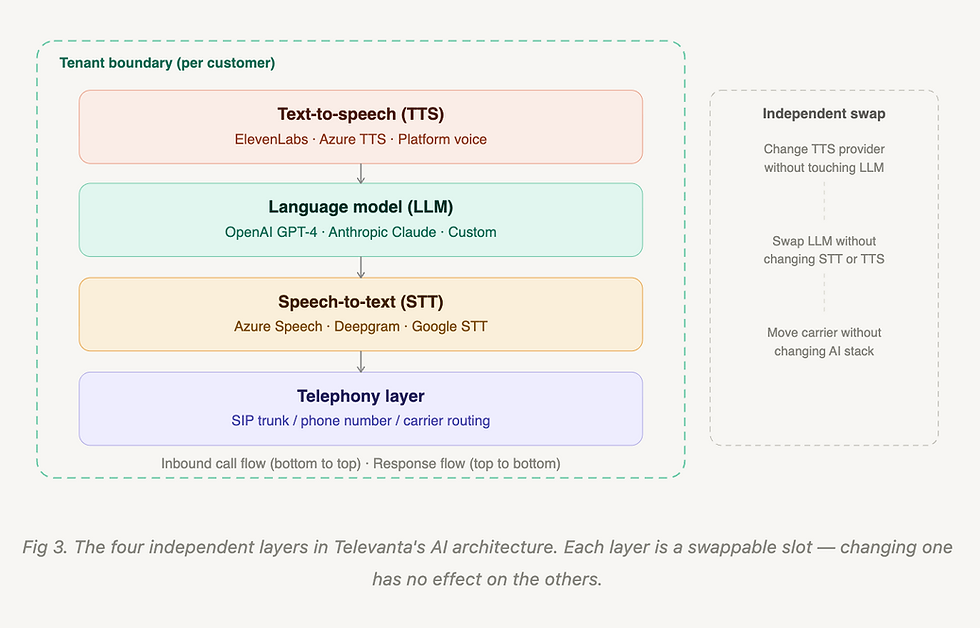
The critical insight here is modularity. When your STT, LLM, and TTS layers are independent, you gain two things at once: the freedom to optimise each layer separately, and protection from a single provider's outage taking down your entire service.
On Televanta, swapping a customer from one LLM to another requires a single dropdown change in the operator portal. There's no redeployment, no rebuilding of the voice pipeline, no downtime. The layers don't know about each other, they only know about the data they receive and the data they return.
This also means that a customer in the healthcare sector can use a HIPAA-compliant LLM configuration while a hospitality customer on the same platform uses a different model entirely. Their configurations never interact.
SIP trunking and call routing in isolated environments
Telephony is the layer where isolation failures are most immediately visible to end users. If call routing logic bleeds between tenants, you get misdirected calls, a patient trying to reach a clinic being answered by an insurance agent's AI, or worse.
SIP (Session Initiation Protocol) trunking is the underlying technology that connects an AI voice platform to the public telephone network. A SIP trunk is essentially a virtual phone line that carries calls over the internet. On a properly isolated platform, each customer's SIP trunk is associated exclusively with their tenant environment — their phone numbers, their call routing rules, their escalation targets.
This matters for several reasons beyond security. It means customers can bring their own carrier, connecting their existing phone numbers and carrier contracts to the platform without porting or forwarding. It means they can set their own routing rules (business hours, overflow handling, geographic routing) without those rules ever intersecting with another customer's configuration.
It also means their call logs capture accurate data about their calls, not a blended view that includes test calls or misconfigured traffic from elsewhere on the platform.
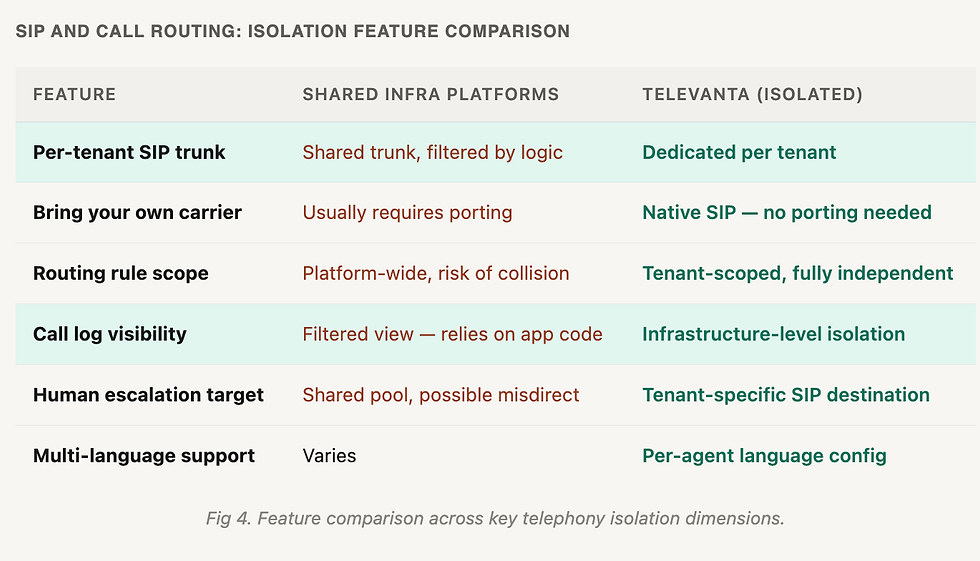
SIP and call routing: isolation feature comparison
Feature | Shared infra platforms | Televanta (isolated) |
Per-tenant SIP trunk | Shared trunk, filtered by logic | Dedicated per tenant |
Bring your own carrier | Usually requires porting | Native SIP — no porting needed |
Routing rule scope | Platform-wide, risk of collision | Tenant-scoped, fully independent |
Call log visibility | Filtered view — relies on app code | Infrastructure-level isolation |
Human escalation target | Shared pool, possible misdirect | Tenant-specific SIP destination |
Multi-language support | Varies | Per-agent language config |
Fig 4. Feature comparison across key telephony isolation dimensions.
When AI hands the call to a human
One aspect of call isolation that rarely gets discussed is what happens at escalation, the moment the AI decides it can't handle a call and transfers it to a human agent.
On many platforms, escalation means dropping the call into a shared queue, losing context in the process. The human agent picks up with no information about what was already discussed, and the caller has to start over. This is frustrating for customers and embarrassing for the business.
On a properly isolated platform, escalation works differently. The AI announces the transfer and connects the caller to the specific human destination configured by that tenant — their own SIP endpoint, their own call centre queue, their own on-call number. Context can be passed along with the transfer: a brief summary of what was discussed, the caller's stated issue, the outcome the AI was trying to achieve.
Critically, the escalation target for one tenant is completely invisible to every other tenant on the platform. If you're running three AI agents, an appointment setter, a general info line, and an emergency escalation line each one transfers to the right destination every time, with no risk of cross-contamination from other customers' routing configurations.
What to look for when evaluating a platform
If you're running or building a business that handles customer calls, here are the questions worth asking any AI voice platform before you commit.
Where is call data stored, and how is tenant separation enforced? Ask them to describe whether isolation is logical (application-level filtering) or physical (infrastructure-level partitioning). Both can be sufficient, but you want to understand which one you're relying on.
Can one tenant's configuration affect another's? In a properly isolated system, the answer should be an unequivocal no, not "we have safeguards against that" but "it's architecturally impossible."
What happens to the AI stack when you change providers? If swapping the TTS provider requires rebuilding the LLM integration, the layers are too tightly coupled. You want a platform where the layers are genuinely independent.
How does escalation routing work, and can routing rules bleed between tenants? Get a clear technical answer, not a marketing answer.
Can you connect your existing phone numbers and carrier? A platform that requires porting or forwarding is a platform that doesn't fully isolate your telephony.
Televanta was built from the ground up to answer all five of those questions clearly. Every customer operates in a fully isolated environment — their agents, phone numbers, call logs, and AI configurations are kept completely separate. No data bleeds between accounts. No customer can see or affect another's calls or settings. And the AI stack is modular at every layer: swapping a provider is a dropdown change, not a redeployment.
"Televanta is the employee you can never hire — always on, always consistent, and with a paper trail for every conversation." — Dennis Truman, Marketing and Sales Director
The voice AI market is growing fast, and for good reason the technology genuinely works. But "works" and "works securely at scale" are different bars. As the platforms mature and enterprise buyers get more sophisticated, the ones that survive will be the ones that got the architecture right from day one.
Data isolation isn't a checkbox. It's the foundation everything else rests on.
Comments