AI phone agents for healthcare: how clinics are automating patient calls in 2026
- May 27
- 5 min read

Your front desk opens at 8 a.m. By 8:07, there are already six calls in the queue.
A patient needs to reschedule a follow-up. Another is calling for lab results. Two are confirming tomorrow's appointments.
One wants to know if you accept their new insurance. And one — the one your staff dreads — is calling for the third time this week about something the doctor already answered.
This is what Tuesday morning looks like for most clinics. And in 2026, the practices that are winning on patient experience have stopped trying to hire their way out of it.
AI phone agents are becoming a genuine operational layer in healthcare. Not clunky IVR trees. Not offshore call centers.
Conversational AI that speaks naturally, understands context, and actually completes the task. Here is what that looks like, why it is happening now, and what the clinics getting it right have figured out.
The phone call problem nobody talks about honestly
Despite years of patient portals and digital check-in, 60 to 75 percent of patient contacts still happen over the phone.
That number barely moves year over year. Patients trust it. They reach for it when something feels urgent. And it is the channel where your practice makes its first impression on almost every new patient.
The problem is not that front-desk staff are underperforming. A good front-desk team working flat out can handle 40 to 60 calls in a shift.
When volume spikes after a holiday weekend or a physician sends out a batch of test results, that ceiling gets hit fast. Calls go to voicemail. Hold times stretch. Patients lose patience and call the next practice on Google.
"We were losing new patients before they ever made it to the front desk. If no one picked up, they called somewhere else."
The deeper issue is that a significant portion of those calls are routine. Appointment reminders. Prescription refill requests. Insurance questions. Directions.
These tasks are not complex but they consume the same staff attention as the calls that genuinely require a human. That imbalance is what AI phone agents are built to fix.
What AI phone agents actually handle today
The category has matured. Today's healthcare AI voice agents are not just answering FAQs — they are completing full call workflows that used to require a staff member at every step.
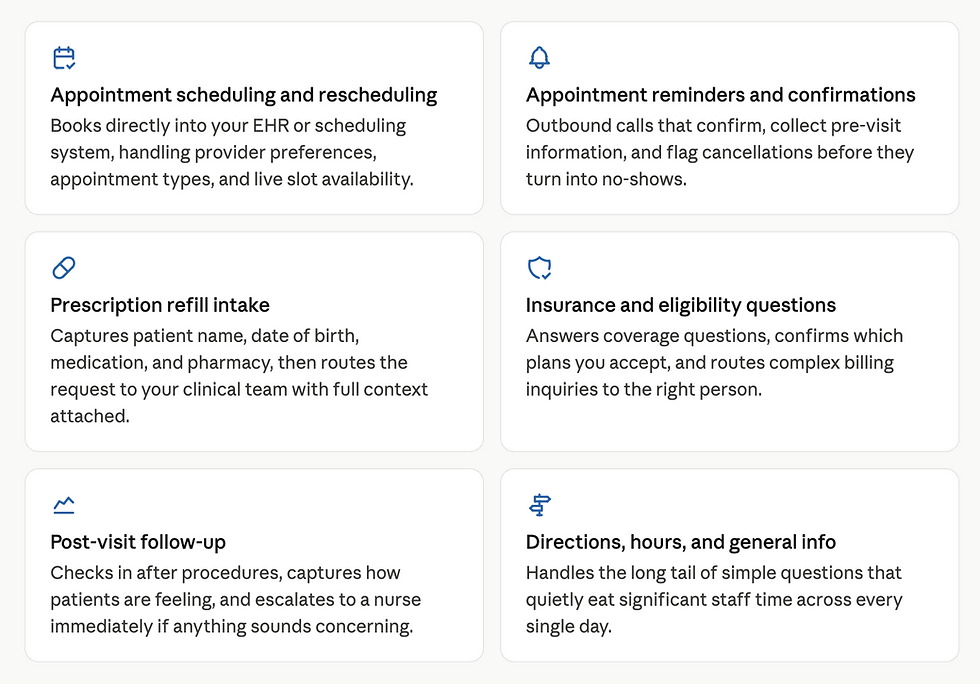
The common thread: these are all tasks where the patient needs an accurate answer and a completed action. Not empathy, not clinical judgment, not relationship building. Those calls still go to your team. The AI handles everything else.
The compliance question you should ask first
Healthcare is different from every other industry deploying AI voice agents. Any vendor who does not lead with compliance has not built for healthcare. Patient calls involve PHI. The moment a patient says their name and date of birth — which happens on almost every call — HIPAA applies.
A healthcare-ready AI phone platform should clear every item on this list before you discuss pricing or a demo.
Compliance checklist
A Business Associate Agreement available and ready to sign before deployment
All call audio and transcripts encrypted at rest and in transit
PHI not used to train models or retained beyond your defined retention window
Audit logs available for HIPAA compliance documentation
Clear escalation protocols so any call involving clinical urgency routes immediately to a human
Configurable consent disclosures at the start of each call
Practices that rush past this checklist during vendor evaluation tend to discover the gaps at the worst possible moment. Vet compliance first. Everything else comes second.
What a real rollout looks like
The clinics getting the most out of AI phone agents share one thing in common: they do not try to automate everything on day one.
They start with the highest volume, lowest complexity call type — usually appointment reminders or after-hours scheduling — and they measure what actually happens. Then they expand from there.
A typical 90-day deployment looks like this. Weeks one through three are configuration and integration: connecting the agent to your scheduling system and EHR, training it on your specific providers, locations, and call scripts.
Weeks four through eight are a supervised launch where staff can see exactly how the agent handles calls and flag anything that needs adjustment.
By week twelve, most practices have settled into a configuration that handles 55 to 70 percent of inbound call volume without human intervention.
The goal is not a fully automated front desk. It is a front desk where your staff handles the calls that actually need them.
Staff response tends to be the thing administrators worry about most before launch. It shifts quickly once the team sees the result.
Front-desk staff are not replaced — they are freed from the repetitive queue and refocused on complex scheduling, insurance navigation, and the patient interactions that genuinely require a human being on the line.
The numbers practices are reporting
Aggregate data from AI-assisted practices is getting more reliable as more deployments reach maturity.
Across healthcare AI voice deployments, practices are reporting no-show rates dropping 20 to 30 percent when AI handles outbound confirmation calls, after-hours call abandonment falling sharply when scheduling is available around the clock, and front-desk teams spending measurably more time on complex, billable coordination work rather than routine intake.
The economics are direct. A single AI phone agent operating 24 hours a day, seven days a week costs a fraction of even part-time staffing while handling a volume of calls no human team could match at peak. For multi-location practices, the math becomes even more compelling.
What separates good AI phone agents from bad ones
Not all AI voice solutions are equal, and healthcare is unforgiving when the technology underperforms. A few things worth pressing vendors on before you commit.
Latency matters more than most people expect. A natural phone conversation has a roughly 200 to 400 millisecond response window before silence starts feeling like a hang. AI voice platforms that are not optimized for healthcare call patterns can feel stilted and robotic. Ask to hear a live demo call, not a curated recording.
Graceful fallback is just as important as what the agent handles well. It will encounter calls it was not configured for.
How it behaves in those moments — does it confuse the patient, or does it say "let me transfer you to someone who can help" — tells you everything about whether it was built for real clinical environments.
EHR integration has to go both ways. An agent that can tell a patient their appointment is confirmed but cannot actually see the schedule is not much better than a voicemail.
Real-time, bidirectional integration with your scheduling system is a baseline requirement, not a premium feature.
And the agent needs to sound like your practice. Patients calling your clinic expect to speak with your practice, not a generic AI product. The best platforms let you define the agent's name, tone, and specific call flows so it feels like a natural extension of your team.
Is 2026 the year to move?
The practices that adopted AI phone agents in 2024 and 2025 have had time to optimize, measure, and expand.
They have also quietly differentiated themselves on patient experience — answering calls faster, cutting hold times, and making scheduling feel effortless.
The gap between those practices and ones still running fully manual operations is now visible in patient satisfaction scores and new patient acquisition.
The technology is no longer experimental. The compliance frameworks are in place. The EHR integrations exist. What is left is the decision to start.