Picture this: it's 11:47 PM on a Tuesday and a hotel guest calls to ask about a late checkout. A patient tries to reschedule a morning appointment while a new insurance lead wants a quick quote before they go with someone else.
Your front desk is closed and your agents are off the clock. Those calls go to voicemail, or worse, they hang up.
This is the problem that AI call agents were built to solve. In 2026, businesses that haven't made the switch are feeling the gap in missed calls, lost revenue, and burned-out staff.
In this post we'll walk you through everything: what an AI call agent actually is, how it works, what it costs, how to pick the best one, and why the human vs. AI debate is probably the wrong question to be asking.
AI Call Agent
An AI call agent is software that handles phone calls autonomously using artificial intelligence. It listens, understands what the caller is saying, and responds in natural spoken language, just like a person would, except it never needs a coffee break.
The technology behind this has come a long way fast — early phone bots could barely handle "press 1 for sales." Today's AI call agents understand natural language, handle back-and-forth conversations, and detect when a caller is frustrated and needs a human.
Under the hood, most AI call agents combine large language models for understanding and generating responses with speech-to-text and text-to-speech engines. Telephony integration ties it all into your existing phone system.
- 1Call arrives
Caller dials your number. The AI agent picks up immediately. No hold queue, no missed call, no matter the time or day.
- 2Speech to text
The caller speaks naturally. A speech-to-text engine transcribes the audio in real time, word for word.
- 3LLM understands intent
A large language model processes the transcription and identifies what the caller actually wants. Not just keywords, but real meaning.
- 4Agent takes action
Checks your calendar, pulls the customer record, looks up the answer. Integrations make this real-time and accurate.
- 5Natural voice response
A neural text-to-speech engine converts the response into natural, human-sounding speech. The caller hears it within milliseconds.
- 6Escalate or wrap up
If the call needs a human, it transfers via SIP with full context. Otherwise the agent logs the call, sends a follow-up SMS, and closes the loop.
Best AI Call Agent
Not all AI call agents are created equal. Choosing the best one comes down to a handful of criteria that actually matter in practice.
Neural voice models that produce natural rhythm and tone. Robotic voices destroy trust immediately. Always test it before committing.
Many platforms only handle English well. Look for genuine multilingual support across 30+ languages so every caller is served in their own language.
Must connect to your calendar, CRM, and ticketing system. An agent that can't book appointments has limited real-world value.
The best platforms let non-technical teams deploy a live agent in minutes. No code, no IT project, no waiting around.
When the agent reaches its limit, it transfers cleanly over SIP with full call context. Poor escalation damages trust just as much.
Unlimited simultaneous calls with no queue. During peak hours, any limit means some callers still wait.
Multi-tenant architecture with strict data isolation per client. Critical in healthcare, insurance, and finance.
AI Call Agent Software
The AI call agent software market has grown significantly in the last two years. The categories break down clearly, and knowing which one you fall into saves a lot of wasted evaluation time.
Deep API access and fine-grained control. Powerful if you have an engineering team. Very steep learning curve without one.
Built for large organizations with dedicated implementation teams. Feature-rich, but expensive and slow to deploy for most businesses.
Built for human agents first. AI capabilities are bolted on rather than built in, and it shows in how well they actually work.
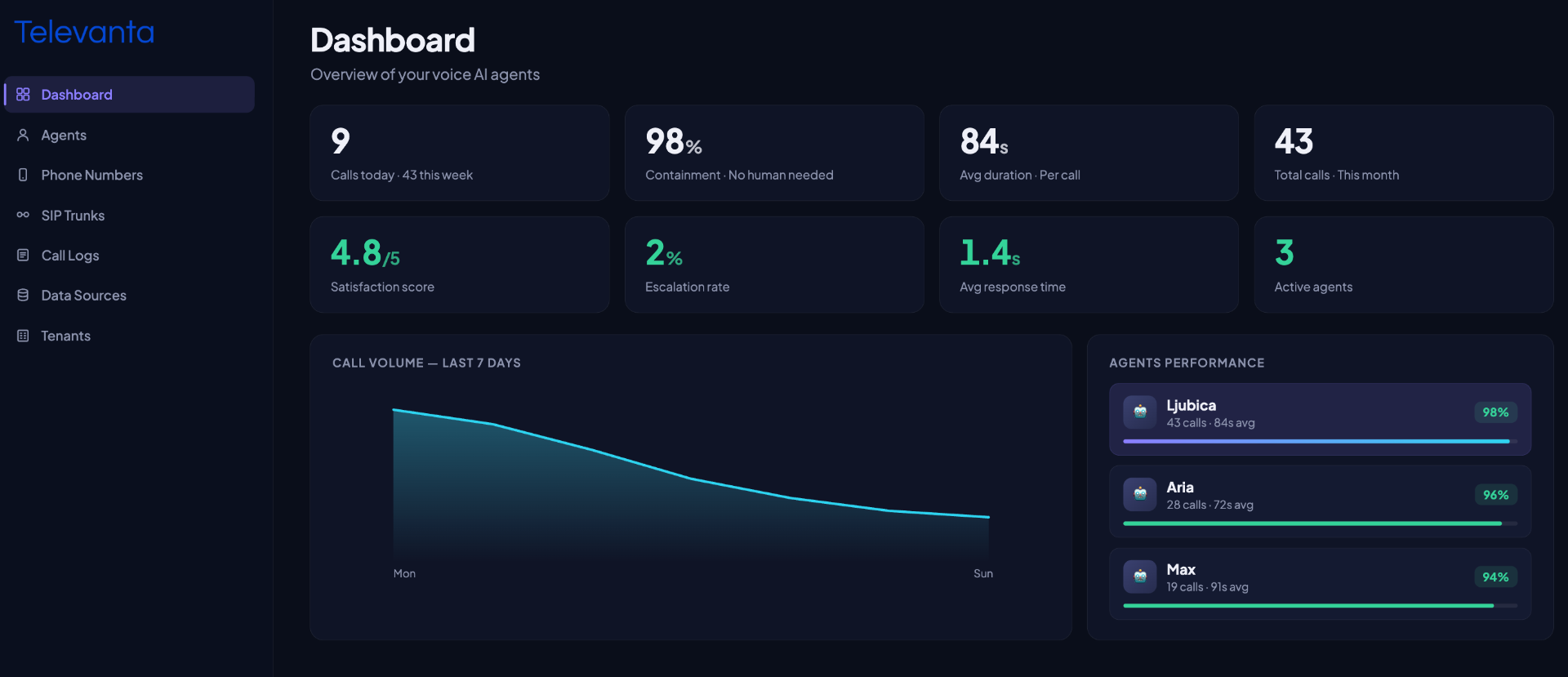
Built so any business can deploy a production-ready AI agent in minutes. No code, no IT, and no compromises on data privacy.
What Is an AI Call Agent
An AI call agent is a software system that conducts voice phone calls on behalf of a business using artificial intelligence. It replaces or supplements human agents for high-volume, repetitive, or time-sensitive interactions.
Here is how a typical AI call agent works: a caller dials your number, the agent greets them and processes their request through a large language model that understands meaning. The agent formulates a response, converts it to speech, and the loop continues until the interaction is complete.
"The caller speaks naturally, the agent understands intent rather than commands, and responds the way a knowledgeable, patient team member would. One that never puts people on hold."
What makes today's AI call agents genuinely different from the phone trees of the past is that they understand meaning rather than menu selections. You just say "I need to change my appointment to Thursday" and the agent handles it.
AI Call Agent for Small Business
For small businesses, the economics are particularly compelling. You don't have the staff to cover all the hours customers want to reach you, and the people you do have are too valuable to spend the day answering the same questions.
A receptionist at a dental clinic might spend 60 to 70 percent of their day scheduling and confirming appointments. A small hotel front desk or an insurance office fields the same status and check-in questions every single day.
The top four rows can be fully automated. That frees your team for the 20% that genuinely needs a human.
Your business becomes reachable 24/7 without hiring overnight staff. Every call that gets a fast, accurate answer is a customer who feels looked after.
Staff satisfaction typically improves too. When the repetitive grind is removed, people can focus on the work they were actually hired to do and they do it better.
AI Call Agent Pricing
Pricing for AI call agents varies widely. Here is a realistic breakdown of what you can expect to pay, including what Televanta charges specifically.
All-inclusive: multilingual (30+ languages), unlimited concurrency, SMS follow-ups, integrations.
Base rates look attractive, but integrations, multilingual support, and SMS often cost extra on top.
Better value for predictable higher-volume businesses. Usually capped on usage or agents.
Custom SLAs, dedicated support, bespoke integrations. For large-scale deployments.
Watch out for platforms that advertise a low per-minute rate but charge separately for calendar integration, SMS follow-ups, or multilingual support. Make sure you're comparing all-in costs and check for minimum commitments or overage fees during high-volume months.
AI Call Agent vs Human Agent
This question deserves a direct answer rather than a marketing spin. The truth is that each excels at different things, and the businesses getting the most value are using both strategically.
- 24/7 availability. Never sleeps, never sick, no turnover.
- Consistent quality. Same professional response on every call.
- Unlimited scale. Handles 100 simultaneous calls without degrading.
- Repetitive tasks. Scheduling, FAQs, status updates, lead qualification.
- Response speed. Zero hold time, millisecond replies.
- Deep empathy. Reads emotional subtext in distress situations.
- Unexpected scenarios. Judgment and creativity when nothing matches.
- Relationship building. High-value long-term customer connections.
- Sensitive negotiations. Pricing disputes and escalated complaints.
Give the 80% to AI. Your team focuses entirely on the 20% that genuinely needs a human, and delivers better outcomes for all of it.
The real insight is that framing this as AI vs. human misses the point entirely. The businesses getting the most value from AI call agents use them to handle the volume that would otherwise overwhelm their team, so their people can focus on the interactions that actually require human skill.
Why Televanta
If you've read this far, you're seriously considering making the switch. Here's why Televanta is worth your attention.
Televanta was built specifically for businesses that need a production-ready AI call agent without a complex technical implementation. You can have your first agent live in under a minute — no developers, no IT project, no month-long onboarding.
Televanta's AI voice agent is built on a multi-tenant architecture with strict data isolation between clients. This matters enormously in regulated industries like healthcare, insurance, and finance, where data privacy is a legal and ethical obligation.
Unlimited concurrent calls means your system doesn't break down at peak times. Whether you have three callers or three hundred, every one of them reaches a responsive, professional agent immediately.
When a call genuinely needs a human, Televanta hands it off cleanly over SIP with the full call context intact. Your staff steps in with everything they need — no awkward re-explanations, no frustrated callers.
The businesses using Televanta span healthcare clinics, hotel groups, telecom providers, insurance agencies, and customer service operations across multiple countries. The use cases differ, but the core need is the same: calls that get answered, customers that feel looked after, and a team that isn't buried in repetitive phone work.
The question is whether it's your team answering every single one, or whether you've built something smarter. See what Televanta sounds like for your business in a 30-minute demo.