An AI phone agent is a voice based virtual assistant that can answer a phone call, understand what the caller is actually asking for in natural, everyday language, and take real action, such as checking an account balance, booking an appointment, or resolving a billing question, without needing a human agent on the line. For telecom companies, that capability could not have arrived at a better time.
Anyone who has ever called a telecom provider knows the drill. You dial in, sit through an automated menu that never quite matches your problem, wait on hold for what feels like forever, and then repeat your account number three times to three different people before someone can actually help you. It is not that telecom support teams do not care. It is that the volume of calls, from billing questions to network outages to plan changes, has grown far faster than the number of humans available to answer them.
This is exactly the gap that an AI phone agent for telecom is built to close. Below, we walk through a made up but realistic scenario of a telecom provider adopting this technology through Televanta, and break down exactly how the agent is built, trained, and connected to the tools that make it useful.
A telecom provider drowning in repeat calls
Picture a mid sized telecom operator serving around two million subscribers across postpaid and prepaid plans, home broadband, and fiber internet. Like most telecom companies, its support lines get hammered every month around the billing cycle. Customers call to dispute charges, activate new SIM cards, check the status of a fiber installation, report an outage, or simply ask what their current plan includes.
The company's internal data told a familiar story. Average hold time was sitting close to eight minutes during peak hours. A large share of calls, close to sixty percent by the support team's own estimate, were for simple, repetitive requests that did not need a human's judgment at all. Meanwhile, night and weekend coverage was thin, so anyone with a problem outside business hours had to wait until the next day. Agents were burning out on the same five questions over and over, and customers were growing frustrated with a support experience that felt slow no matter how good the actual staff were.
The company's leadership decided to bring in an AI voice agent for telecom customer support, and they chose Televanta to build and run it.
Setting up an AI phone agent for telecom in Televanta
Televanta's approach to building a telecom AI voice bot follows a fairly structured path, and it is worth walking through because the setup process is where most of the value actually gets created.
Before any script is written, Televanta's team maps every common reason people call: SIM activation, number porting, plan changes, billing disputes, outage reports, technician booking, and general account questions. Each becomes its own conversation flow with its own success criteria.
For every call reason, the flow describes what information the agent needs to collect, what it needs to verify, and what action closes the request. This is where the agent stops being a generic chatbot and starts behaving like a member of the support team.
The agent integrates with the CRM, the billing and account management system, the network operations dashboard for outage data, and the scheduling tool for technician visits. Without this step, it would be a nice sounding voice with no real ability to help.
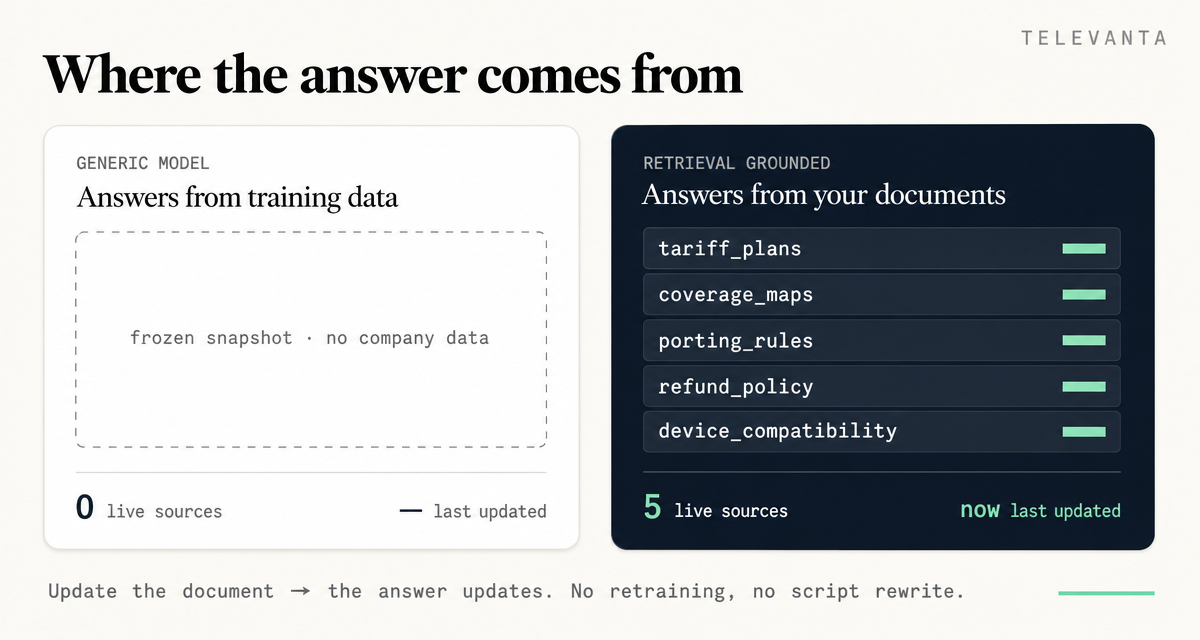
Internal documents, tariff sheets, refund policy, SLA terms, porting rules, and troubleshooting guides go into a retrieval system so the agent always answers from verified company information rather than guessing or searching the open internet.
Before going live, the agent runs through hundreds of simulated calls covering edge cases: angry customers, unclear requests, background noise, and callers switching topics mid conversation.
At launch, every call the agent cannot confidently resolve is routed to a live agent along with a full summary, so no customer is ever left stuck.
Giving the agent behavior guardrails, not just a script
One of the most important parts of building an AI voice agent for telecom is deciding how it should behave, not just what it should say. Televanta's platform lets teams write detailed behavior instructions that shape tone, boundaries, and escalation logic. Here is a simplified version of the guidance the support team wrote for their agent, which they named Nova.
"You are Nova, the voice assistant for this telecom provider. Speak in a warm, calm, and professional tone at all times. Before sharing any account specific detail, confirm the caller's identity using two of the following: registered mobile number, date of birth, or the last four digits of their ID on file. Never estimate a billing amount, a plan price, or an outage repair time. Always retrieve that information from the knowledge base or the live system first. If a caller sounds upset or frustrated, acknowledge it briefly in one sentence before moving on to solve the problem. If you are not confident in an answer after checking the available information, say so honestly and transfer the caller to a live agent rather than guessing. Keep responses short and clear, and never make promises about refunds, discounts, or compensation beyond what is written in the official policy document."
This kind of explicit guidance matters enormously. It is the difference between an AI phone agent for telecom that customers trust and one that makes something up and creates a bigger problem than the one it was supposed to solve.
What a call with Nova actually sounds like
Scheduling a fiber installation
A customer calls asking to schedule fiber installation. Nova asks for the service address, checks availability against the real scheduling system, and offers two open slots within the next three days. Once the customer picks one, Nova books it directly, sends a text confirmation, and reads back the appointment details before ending the call.
Checking a network disruption
A customer in a specific neighborhood calls in during an outage. Nova checks the live outage dashboard by area code, confirms there is a known issue, gives the estimated restoration window engineering has posted, and offers to text the customer the moment service is restored instead of asking them to call back.
Resolving a billing dispute
A customer disputes a charge on their bill. Nova pulls the actual billing record, explains what the charge is for using the plan document as its source, and if the customer still disagrees, opens a dispute ticket and transfers the call to a billing specialist with full context already attached, so the customer never has to explain the issue twice.
Activating a new SIM card
A new customer calls to activate a SIM card. Nova verifies the account, confirms the plan selected at purchase, walks the customer through the activation steps, and confirms activation is complete by checking the network status directly, rather than simply telling the customer to wait and see.
In every one of these cases, the value is not that a computer answered the phone. It is that the AI voice agent for telecom completed a real task using real, current information and closed the loop without a hand off unless one was genuinely needed.
Teaching the agent to look in the right place with RAG
A telecom company has an enormous amount of internal documentation: tariff plans that change every quarter, regional coverage maps, porting regulations, device compatibility lists, and refund policies that vary by plan type. If an AI call agent for telecom tries to answer questions from general internet knowledge, it will get things wrong constantly, because none of that information is public or current.
This is why Televanta builds every telecom deployment on retrieval augmented generation, commonly called RAG. Instead of relying on what a language model was trained on, the agent searches the company's own internal document library in real time for every question that requires factual accuracy. When a customer asks how long they have to return a device, or what the early termination fee is on a two year contract, Nova retrieves the exact passage from the company's actual policy documents and answers based on that, not on a guess.
Setting this up is far simpler than most support teams expect. There is no complicated data pipeline to build and no need to reformat anything first. The team can add documents straight from their own computer in whatever format they already have on hand, PDF, Word, Excel, plain text, even scanned files, and Televanta turns them into a searchable knowledge source the agent can pull from right away. A tariff sheet sitting in someone's downloads folder or a policy document buried in a shared drive can become part of the agent's knowledge base within minutes.
This approach also makes the agent easy to keep accurate. When the company updates a tariff plan or changes its refund window, the support team simply updates the document, and Nova's answers update automatically. There is no need to retrain a model or rewrite a script every time a policy changes, which is a common pain point with older, purely scripted IVR systems.
Connecting the agent to the tools that get things done
A conversational AI for telecom is only as useful as the systems it can actually reach. Televanta's platform connects the AI phone agent directly into the software a telecom company already runs, rather than asking the company to rebuild its infrastructure around the AI.
- CRM for identity verification and account history
- Billing and account management for real time balance and plan information
- Scheduling software for technician and installation appointments
- Outage and network operations for accurate, area specific status updates
- Ticketing system so unresolved issues get logged and handed off with full context
This is what turns an AI receptionist for a telecom provider into something genuinely useful. The agent is not reading from a static script. It is checking a live appointment calendar before offering a time slot. It is reading an actual account balance before discussing a bill. It is checking a real outage feed before promising a repair window. That accuracy is what earns customer trust over time.
What changed after launch
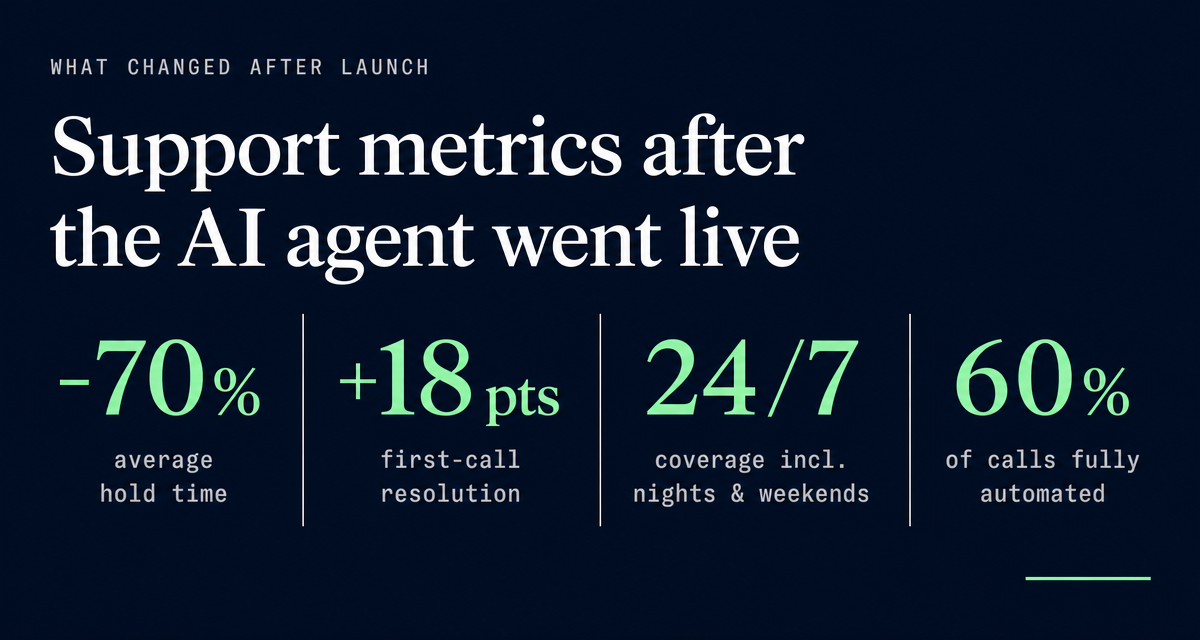
Within a few months of rolling out its AI powered telecom customer support agent, the company saw meaningful shifts across its support operation. Average hold times dropped sharply because Nova handled the high volume, repetitive requests instantly and around the clock. First call resolution improved because Nova had direct access to live account and network data rather than needing to transfer callers between departments. Support staff had more time to focus on complex complaints and retention conversations instead of repeating the same basic answers dozens of times a day. And because Nova was available at two in the morning just as easily as at two in the afternoon, customers with urgent issues outside business hours no longer had to wait until the next day to get help.
None of this replaced the company's support team. It gave them room to actually do the parts of the job that need a human, while the automated telecom call center handled everything that was routine, well documented, and time sensitive.
Why are telecom companies turning to Televanta?
Televanta's AI communication platform was built with exactly this kind of use case in mind. It combines natural sounding voice conversations, retrieval based knowledge grounding, and direct integration with the systems a telecom company already relies on, billing platforms, CRMs, scheduling tools, and network operations dashboards, into a single agent that can carry a real conversation and actually finish the task at hand.
For telecom providers evaluating an AI voice agent for their support line, the lesson from this example is fairly simple. The technology is not about replacing people. It is about giving customers faster, more accurate answers for the questions that do not need a human judgment call, while making sure every conversation is backed by the company's real policies, real account data, and real time status information rather than a best guess. That combination, natural conversation, grounded knowledge, and deep system integration, is what separates a genuinely useful AI phone agent for telecom from a fancier version of the same old frustrating phone tree.
If you want to hear what this sounds like on your own support line, book a demo and we will walk you through a live telecom setup.
Billing cycles, outages, and porting rushes all hit at once. Televanta's agent handles the spike in parallel, so hold times stay flat even on the busiest day of the month.
Common questions about AI phone agents for telecom
An AI phone agent is a voice based virtual assistant that answers calls, understands what the caller is asking in natural language, and takes real action, such as checking an account balance, booking an appointment, or resolving a billing question, without needing a human agent on the line.
An IVR forces callers through fixed menus and keypad options. An AI phone agent understands natural speech, verifies the caller, pulls live account and network data, and completes tasks end to end. Callers describe their problem in their own words instead of navigating a phone tree.
Televanta connects the agent to the CRM, billing and account management platform, scheduling software, outage and network operations systems, and the ticketing system. The agent reads and acts on live data rather than a static script.
The agent is grounded in the company's own documents through retrieval augmented generation. When a tariff plan or refund window changes, the support team updates the document and the agent's answers update automatically, with no retraining or script rewrites.
Any call the agent cannot confidently resolve is transferred to a live agent with a full summary attached, so the customer never has to repeat themselves or start over.