
Ask a B2B company where its customer experience breaks down and the answer is often the phone. A distributor calls at five to five to ask where a pallet is. They hear a menu with five options, pick the wrong one, wait in a queue, and finally reach someone who has to put them on hold while they look the order up in the ERP. Now multiply that by a few hundred calls a week. You end up with tired staff, impatient buyers and a phone setup that costs far more than it should.
An intelligent AI IVR is built to fix exactly this. A traditional phone tree only sends calls somewhere. An AI IVR answers the question itself when it can and passes the call to the right person when it can't. Below we look at what separates the best IVR solution from the usual "press 1" system, then walk through Televanta IVR feature by feature, with a focus on how B2B teams use it day to day.
What is an IVR solution?
IVR stands for interactive voice response. It is the system that picks up when someone calls your business, plays a greeting and asks the caller where they want to go, either by pressing a key or by saying a word. For decades it has been the front door of almost every company phone line.
A traditional IVR system is good at one thing: sending a call to a queue. It cannot tell a customer when their delivery will arrive or whether a part is in stock. All it decides is which group of people should be asked, and then the caller waits for one of them to become free.
AI IVR software changes the job of that front door. The menu can stay exactly as your customers know it, but behind it sits an AI voice agent that understands natural speech, looks up live data and finishes the call itself when the answer is routine. When it isn't, the AI passes the caller to the right person along with everything it has learned. If you are weighing the two approaches, our comparison of AI call agents and IVR explains when each one makes sense.
What the best IVR solution needs to do for B2B?
A classic IVR is a switchboard with a recorded voice. It plays a greeting, waits for a keypress and forwards the call. That worked when every question needed a person anyway. In B2B it no longer holds up, because a large share of inbound calls are the same few questions on repeat. Where is my order? What is the lead time? Does this part fit our machine? What does it cost? Are you open on Friday?
For a B2B business, the best IVR solution should handle four jobs well:
- Answer routine questions directly, using live company data
- Route everything else to the right team on the first try
- Hand over full context when a person takes the call, so nobody repeats themselves
- Keep working outside office hours, in the caller's own language
Most legacy systems manage the second job and stop there. Televanta IVR was designed around all four.
Meet Televanta IVR: AI IVR software that answers calls
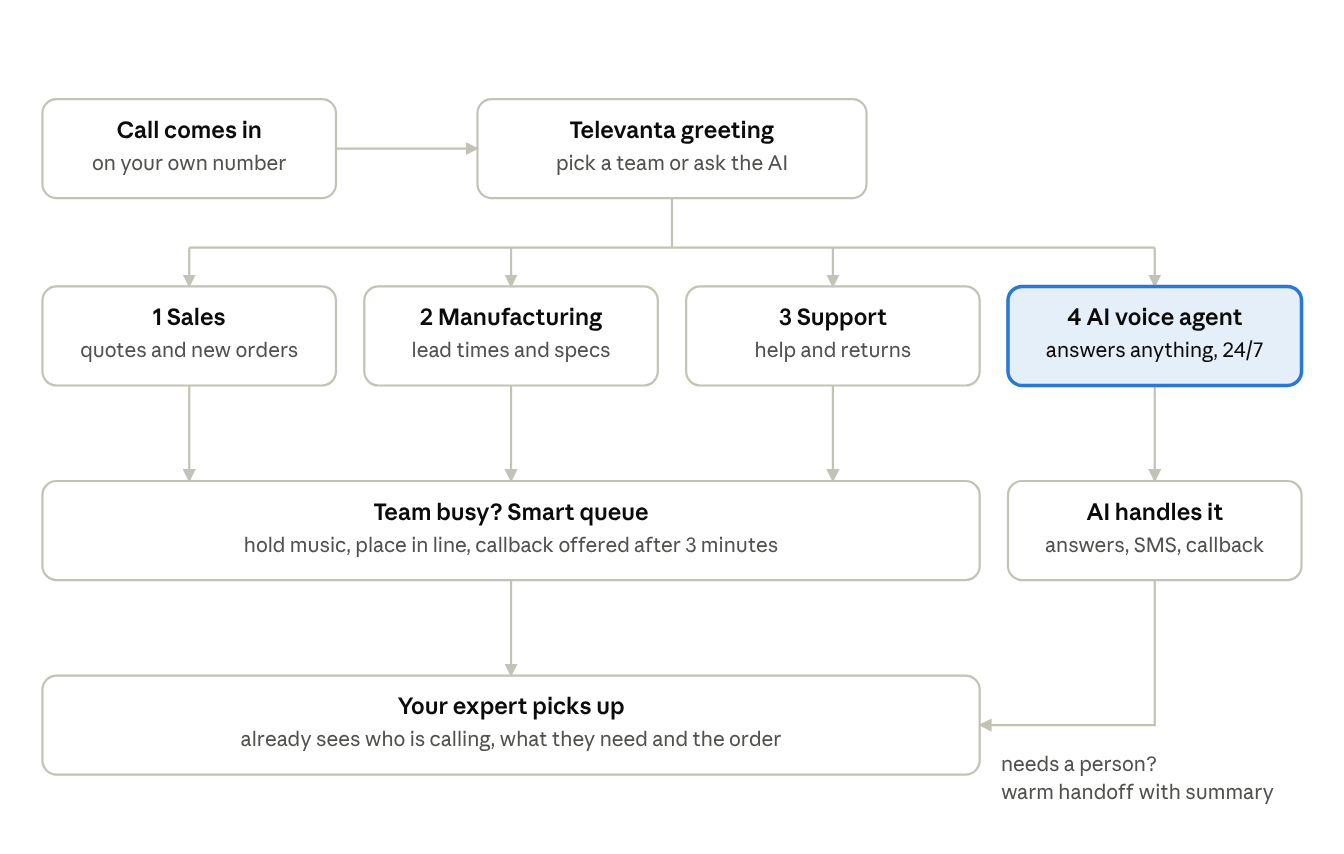
Televanta IVR is AI IVR software for incoming calls that answers questions instead of only routing them. Every caller is greeted and offered a short menu. They can pick a team or go straight to the AI voice agent, which speaks in natural language and can resolve the call on its own.
For a manufacturer, a typical menu looks like this:
- Press 1 for Sales: quotes and new orders
- Press 2 for Manufacturing: lead times and specs
- Press 3 for Support: help and returns
- Press 4 for the AI agent: answers anything, 24/7
You can change menu options and business hours yourself whenever you need to. Your existing phone number stays the same, because you either forward the line or port it. From the customer's side, nothing about how they reach you changes. What changes is what happens after they dial.
Core features and functionality
Routing that gets it right the first time
Callers choose by keypad or simply say what they need. Sales calls land with sales, technical questions with manufacturing, returns with support. When a call does need a person, the AI sends it to the team that can actually help instead of a general queue.
Specialist AI agents behind any menu option
You are not limited to one general assistant. Any menu option can lead to its own specialist AI agent that sticks to its topic. A sales agent handles quotes and order questions, a support agent handles returns and troubleshooting. Each one has controlled actions and knowledge you can update the moment your catalogue or policies change. Keeping agents focused this way makes their answers more accurate, and it makes it far easier for you to check what each one is allowed to say and do.
Live answers from your ERP and knowledge base
This is the feature that makes the biggest difference in B2B. Televanta syncs with your ERP, so the AI can tell a caller the real status of their order, the current lead time or the price on their list. You also load your FAQs, product catalogue and price lists into one shared knowledge base. The agent draws on that to answer questions about specs, products and opening hours. Because the data is already connected, it never needs to put a caller on hold to go and look something up.
Queues that respect the caller's time
Some calls belong with a person, and sometimes everyone is busy. Callers waiting for a colleague hear hold music, know their place in line and can ask for a callback. You can also offer a callback automatically, for example after three minutes of waiting. Nobody has to choose between hanging up and staying on the line forever.
Many callers at once
A human team can take one call per person. The AI agent can talk to many callers at the same time. Monday mornings, end of quarter rushes and the day after a delivery delay stop turning into long queues.
Multilingual by default
The agent replies in the caller's language. Televanta agents work in more than 30 languages, including English, German, Croatian, Italian, French, Spanish and Polish. If you sell across borders, customers abroad get answers in their own language and time zone without you hiring a night team for every market.
Analytics managers will actually use
Televanta reports on response times, missed calls, the top questions callers ask and the AI resolution rate, broken down by team and by week. You can see the workload per team and get supervisor reports on calls and staffing. Over time, this tells you which questions to teach the AI next and where your people are stretched.
Every call outcome is logged
Every call is transcribed and logged with the caller's intent, the sentiment of the conversation and the outcome. Was the question answered by the AI, passed to sales, or turned into a callback for Monday morning? You can check it call by call, and you can see the totals on the dashboard next to calls handled, containment rate, satisfaction and agent performance.
For a B2B team this is more than a nice report. It shows which customers call most often, which products trigger the most questions and where something earlier in the process, such as a clearer order confirmation, could prevent the call altogether.
The Televanta AI voice agent, built into the IVR
The AI voice agent is not a separate product bolted onto the phone system. It lives inside Televanta intelligent AI IVR, which means routing, the agent, queues and human handover all run from the same call flow and the same data.
The agent answers by voice around the clock. It can check orders, answer questions, take messages, book callbacks and send a follow up SMS, such as a tracking number, while the caller is still on the line. Before any caller hears an answer, you test and approve it, so you stay in control of what the AI says on behalf of your business.
Send routine questions and after hours calls to the agent
There are two main ways B2B companies put the agent to work. During the day, callers can press 4 for quick answers to routine questions, which keeps simple order and lead time queries away from your sales and support staff. After working hours, the agent takes the line, so every call is answered even when the office is closed, lines are busy or the team is on holiday. You keep the line open 24/7 without adding shifts.
Here is what that looks like on a Saturday night, with the office closed:
Saturday, 21:40
Caller: Hi, when will my order be delivered?
Televanta AI: Your order is in production and ships on Thursday. Should I text you the tracking number?
Caller: Yes, please. And have Mr. Novak call me on Monday.
Televanta AI: Done. The SMS is on its way, and the callback is booked for Monday at 9:00.
On Monday morning, Mr. Novak finds the callback waiting for him with a full summary of the conversation. The customer got an answer straight away, and nobody had to work the weekend.
Escalation to a human, at any moment
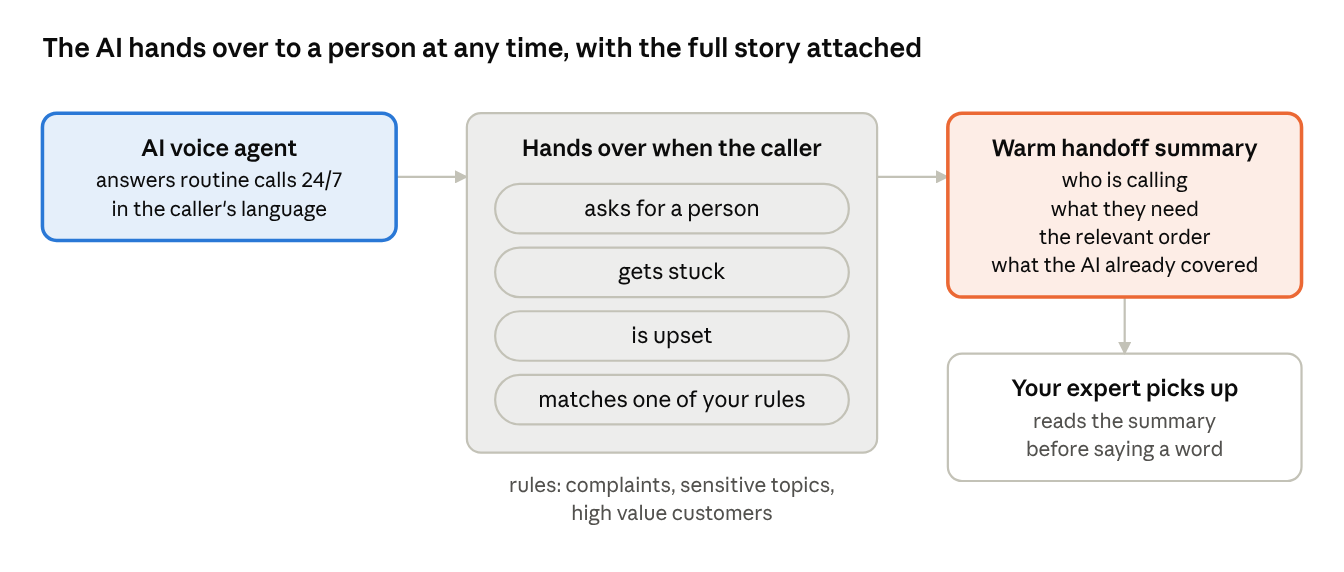
A good AI agent knows when to step aside. Televanta hands the call over when the caller asks for a person, when the conversation gets stuck or when the caller sounds upset. Callers can also press 0 at any time to reach reception. Nobody is trapped in a loop with a bot.
The handover is warm. Before your colleague says a word, they see who is calling, what they need, the relevant order and what the AI has already covered. The caller doesn't have to explain the problem twice, and your expert starts the conversation already up to speed.
Handover rules you control
Beyond the obvious triggers, you decide when the AI should step aside on its own. Common rules cover complaints, sensitive topics and calls from high value customers. A key account manager may want every call from a top customer to reach a person straight away, while a question about opening hours never needs one. You set the rules once and change them whenever your priorities shift.
Why a warm transfer matters in B2B
A cold transfer simply moves the caller to another line, and the person who answers starts from zero. A warm transfer sends the context along with the call. Televanta always does the second. In B2B, where one call can involve an order number, a part reference, a delivery date and a price agreement, that difference saves minutes on every escalation and spares your customer the frustration of explaining everything twice.
How an intelligent AI IVR helps B2B businesses run more efficiently
The real value shows up in how your people spend their day.
Sales stops answering "where is my order" ten times before lunch and gets back to quotes, negotiations and key accounts.
Manufacturing and operations take fewer interruptions about lead times and specs, because the AI answers those straight from the ERP.
Support spends its time on complaints and real problems, not on opening hours and return addresses.
Management gets busy periods, after hours coverage and holiday cover handled without overtime or outsourced night shifts. Missed calls drop because every call is answered, and the analytics show exactly where the hours go.
Customers get answers faster, in their own language, at any hour. When they do need a person, they reach the right one with their context already on screen.
Televanta puts it simply: one phone line, one AI agent and your own experts, doing everything a contact center does without the contact center.
Top B2B use cases for AI IVR
Order status and delivery questions. This is the most common call in manufacturing and distribution, and the easiest to automate. The AI reads the status from your ERP, gives the shipping date and texts the tracking number.
Lead times and technical specs. Buyers and engineers want quick facts before they place an order. The agent answers from your catalogue and spec sheets and passes anything unusual to manufacturing.
Inbound call triage. Quotes go to sales, returns to support, technical questions to the people who know the product. No more transfers from the wrong desk.
After hours and holiday cover. Weekend calls, late evening calls and calls during the summer shutdown get answered, with callbacks booked for the next business day.
International customers. Export customers get answers in their own language and time zone, which matters when your biggest client is six hours ahead.
Peak periods. End of quarter, price changes and delivery delays all create spikes. The AI absorbs them without long queues or temporary staff.
Replacing or shrinking a contact center. Whether it is in house or outsourced, Televanta can take over the routine volume step by step while your experts keep the calls that build relationships.
Televanta also has dedicated solutions for aviation, healthcare, hotels, telecom, insurance and customer support teams.
Keypad IVR versus Televanta IVR
| Keypad IVR with a contact center | Televanta IVR | |
|---|---|---|
| How callers get help | Keypad menus, then a queue | Pick a menu option or ask the AI agent directly |
| Routine questions | Handled by contact center agents | Answered by the AI agent from your ERP and knowledge base |
| Busy periods | Longer queues or extra staff | Many calls answered at the same time |
| After hours | Night shifts or voicemail | AI answers and books callbacks |
| Reaching an expert | Caller is transferred and repeats the issue | Warm transfer with a call summary |
| Order context | Looked up by hand | Synced with your ERP |
How to choose the best IVR solution
Whichever vendor you end up with, these are the questions worth asking before you sign. A polished demo tells you little; the answers below tell you how the system will behave on a busy Monday with a frustrated customer on the line.
| What to check | Why it matters | How Televanta handles it |
|---|---|---|
| Resolution of routine calls | Every call the AI finishes is one your team does not have to take | The AI agent answers from your ERP and knowledge base, and the dashboard tracks containment rate |
| Handover with context | Callers hate repeating themselves | Warm transfer with a summary, and callers can ask for a person at any time |
| Outcome logging | You can only improve what you can see | Every call is transcribed and logged with intent, sentiment and outcome |
| Speed of answers | Silence on the line feels like a dropped call | Data is already connected, so callers are never put on hold while the AI looks something up |
| Phone number and carrier | A new number costs you customers | Keep your number by forwarding or porting, or connect any SIP carrier |
| Languages | Export customers expect their own language | More than 30 languages |
| Control over answers | The AI speaks for your brand | You test and approve answers before any caller hears them |
| Time to value | Long projects lose momentum | Live in days, running alongside your current setup |
| Security | Order and customer data is sensitive | Televanta describes its platform as enterprise grade; ask how data is stored and separated |
Will it work with our current phone system?
In most cases, yes, and without any change your customers would notice. You keep your existing number and either forward calls to Televanta or port the number over. Televanta also works with any SIP carrier, so companies running their own PBX or a cloud phone system can connect it without ripping anything out. Callers can still press keys on the menu if they prefer, or simply say what they need.
Limitations to plan for
No IVR solution is magic, and being honest about the weak spots is the fastest way to a good rollout.
Some callers will always want a person. That is fine. Make it easy for them. With Televanta a caller can ask for a person at any time, and the transfer arrives with full context.
The AI is only as good as your data. If the ERP shows the wrong ship date, the AI will repeat it. Clean up your FAQs, price lists and order data before launch, and keep them current.
Complex conversations belong with people. Negotiations, complaints and custom quotes need judgment. Use handover rules so those calls go straight to the right expert.
Accents and dialects vary. Test with real calls in every language you serve before you switch the line over completely.
It needs light, regular tuning. Review the top caller questions and transfer reasons every few weeks. Each review usually shows one or two new answers worth teaching the AI.
Getting started in four steps
Switching phone systems sounds like a big project. With Televanta it comes down to four steps, and you don't have to switch overnight.
- Keep your number. Forward or port your existing line.
- Map your menu and teams. Set the menu options, teams, business hours and handover rules.
- Teach the AI. Connect your ERP and load your FAQs, catalogue and price lists.
- Go live, then scale. Run Televanta alongside your current contact center and move more calls over as the analytics support it.
The Televanta team configures the first call flow with you, and the platform is built to go live in days. Televanta mentions going live in 7 days and offers a 14 day pilot, so you can hear it on real calls before you move more of your volume over.
Frequently asked questions
What is the best IVR solution for B2B companies?
The best IVR solution for a B2B company is one that resolves routine calls with live data, routes the rest to the right team and transfers callers to people with full context. Televanta IVR was built for exactly that, with ERP integration, an AI voice agent and warm handover in one system.
What is the difference between IVR and AI IVR?
A traditional IVR only routes calls through a keypad menu. AI IVR software adds a voice agent that understands natural speech, answers questions from your systems and completes tasks such as booking callbacks or sending an SMS. Our guide on what AI IVR is covers this in more detail.
Can callers reach a human at any time?
Yes. Callers can ask for a person whenever they want, and the AI hands over automatically when a caller is stuck or upset, or when one of your handover rules applies.
What happens when the AI cannot help a caller?
It transfers the call to the right team with a summary of who is calling, what they need, the relevant order and what has already been covered. If the team is busy, the caller hears their place in line and can ask for a callback.
What is the difference between a warm and a cold transfer?
A cold transfer moves the call without context, so the caller has to start over. A warm transfer passes the conversation summary to your colleague before they pick up. Televanta uses warm transfers.
Does Televanta IVR work after hours?
Yes. The AI voice agent answers 24/7, including weekends and holidays, and books callbacks for the next business day when a person is needed.
Can we keep our existing phone number?
Yes. You can forward your current number to Televanta or port it. Televanta also works with any SIP carrier.
Which systems does Televanta connect to?
Televanta connects to your ERP for live order data and to a shared knowledge base where you load FAQs, catalogues and price lists. It can also work with calendars and order databases.
How many languages does Televanta support?
More than 30, including English, German, Croatian, Italian, French, Spanish and Polish. The agent replies in the caller's language.
Can an AI IVR handle high call volumes?
Yes. Unlike a human team, the AI voice agent can talk to many callers at the same time, so peak periods do not turn into long queues.
How are call outcomes logged?
Every call is transcribed and logged with intent, sentiment and outcome. Reports show response times, missed calls, top questions, AI resolution rate, workload per team and staffing.
How much does Televanta IVR cost?
You can find current plans on the Televanta pricing page, and the ROI calculator helps you estimate savings against your current call handling costs.
Final thoughts
The best IVR solution for a B2B company is the one your customers barely notice, because they simply get what they called for. Televanta IVR brings a clean menu, an AI voice agent connected to your ERP, smart queues and warm handover to people together in one system. Routine questions get answered, after hours calls get handled, and your experts spend their time where they add the most value.
Want to hear it with your own data? Book a demo and Televanta will build a sample call flow with your menu, FAQs and order data, then call you with it so you can hear the result for yourself.
Created on
Antonio Lupieri is an agentic AI leader at Televanta, where he helps businesses automate customer communication across phone, chat, WhatsApp and email. On the blog, he writes about AI voice agents, intelligent IVR, chatbots, WhatsApp bots and AI email assistants.