
The executive blind spot in modern sales
Most leadership teams can tell you exactly how much revenue they booked last quarter. Far fewer can tell you why a deal took 40 days instead of 15, which stage of the process quietly costs them orders every week, or which sales rep is overloaded while another has capacity to spare.
That gap is not a reporting problem. It is a visibility problem. Today, customers reach your company through phone calls, email, website chat and WhatsApp, often switching between channels within the same deal. Each conversation lands in a different place: a personal inbox, a mobile phone, a chat window. Your ERP only sees the final order. Everything that happens before it, the inquiry, the offer, the negotiation and the approvals, is effectively invisible to management.
AI sales automation workflows change that. Instead of asking your team to log every interaction manually, an AI platform reads the communication that already exists, connects it into one timeline per customer and order, and turns it into data management can act on. In this article we look at what that means for executives and C-level leaders, and how Televanta monitors the entire sales lifecycle, from the first call, email, web chat or WhatsApp message all the way to the closed sale and delivery.
Why fragmented sales data forces gut-feel decisions
In many companies, the real sales workflow runs through inboxes and phones. A customer calls with a question, follows up by email with specifications, sends a quick WhatsApp message to ask about delivery dates, and finally confirms the order in a reply to an offer. Every one of those touchpoints carries valuable information. Almost none of it reaches management in a structured form.
The consequences show up in three ways:
- No view of where work gets stuck. Leaders often learn that an order is late only when the customer calls to complain. Nobody can say with confidence which stage slows things down, or why.
- Unbalanced workload nobody can see. One rep is drowning in inquiries while another waits for work. Without data on response times and open deals per person, rebalancing the team is guesswork, and it rarely feels fair.
- Know-how locked in personal inboxes. Prices, past deals and customer history live in private email threads. When an experienced salesperson leaves, that knowledge leaves with them.
Today, the sales workflow runs through inboxes management cannot see
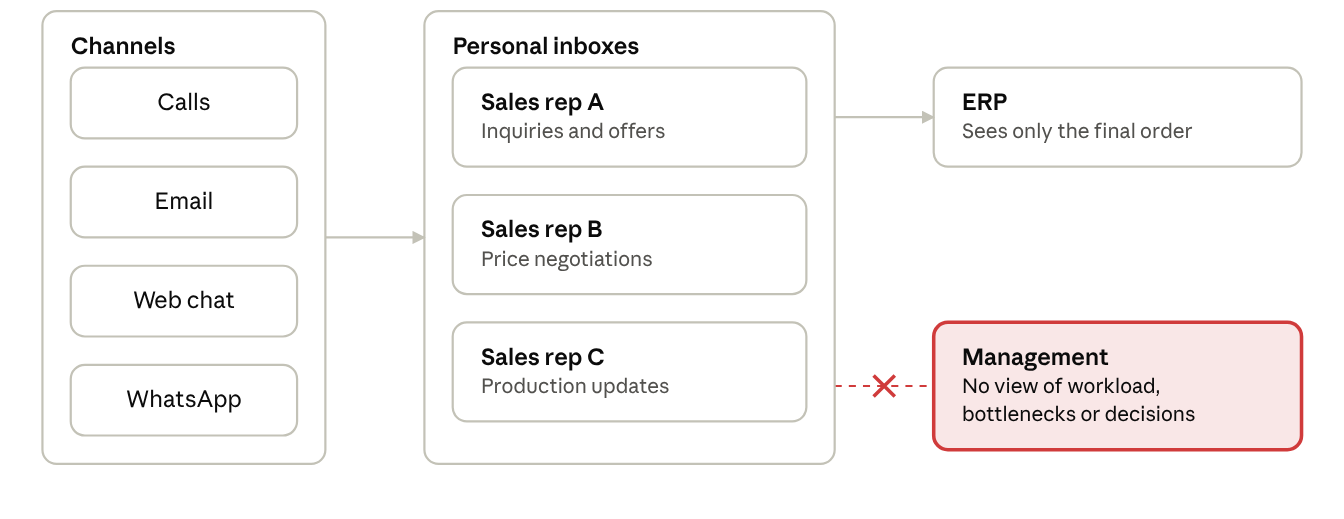
CRM systems were supposed to fix this, but they depend on people entering data consistently. In practice, busy sales teams log the minimum, and the CRM becomes a partial, delayed picture of reality. The result is that decisions about people, pricing, approvals and priorities still come down to instinct. For an executive responsible for growth and margin, that is an uncomfortable place to be.
What an AI sales automation workflow actually is
An AI sales automation workflow is not just a chatbot or an auto-responder. It is a layer of intelligence that sits across all of your customer communication and follows each opportunity from the first contact to the final outcome.
A well-designed AI sales workflow does four things:
- 1. Captures every interaction. Calls are transcribed, emails and attachments are read, and chat and WhatsApp messages are collected, all linked to the right customer and the right deal.
- 2. Understands context. The AI recognises who the customer is, which products they are asking about, what they want and how urgent it is.
- 3. Acts and assists. It routes requests to the right person, drafts replies and offers using your real prices and stock, and keeps the deal moving, while people stay in control of what is sent.
- 4. Measures the process. Because it has seen every step, it can calculate how long each stage takes, where deals stall and what separates won deals from lost ones.
The last point is where the value for executives lies. Automation saves time for the sales team. Measurement gives leadership something it has rarely had: an objective, continuously updated picture of how the commercial engine of the business really performs.
Crucially, the best platforms do this without forcing you to redesign your processes first. Generic workflow tools usually require you to map and rebuild every step before they can help. An AI-native approach reads the workflow that already exists in your communication and learns it as it goes.
How Televanta monitors the entire lifecycle, from first call to sale
Televanta stays with every opportunity from the very first customer touchpoint to the final sale and delivery. Whether a customer starts with a phone call, an email, a website chat or a WhatsApp message, Televanta captures it, connects it to the customer's history and keeps following the deal through every stage. There is no workflow to map and no new tool for your sales team to learn.
It starts with the first ring: Televanta IVR
For many B2B companies, the phone is still where the biggest deals begin, so the journey in Televanta starts at the very first ring. Televanta IVR is an IVR for incoming calls that answers, not just routes. It greets every caller and sends them to Sales, Manufacturing or Support, or lets an AI agent answer the question on the spot, 24/7 and in the caller's own language.
When a person is needed, the call is handed over with a summary, so the customer never repeats themselves. Order status, lead times and specs are answered from live ERP and knowledge base data, even at night, on weekends or when every line is busy.
For leadership, this matters for two reasons. First, a missed call is often a missed order, and Televanta makes sure every call is answered. Second, because Televanta IVR captures each call, its intent and its outcome, the first touchpoint becomes the first data point of a journey that Televanta then follows across email, web chat and WhatsApp, all the way to the sale. Call analytics such as response times, missed calls, top questions and how much the AI resolved flow into the same management view.
From the first ring to the sale, every touchpoint lands on one timeline
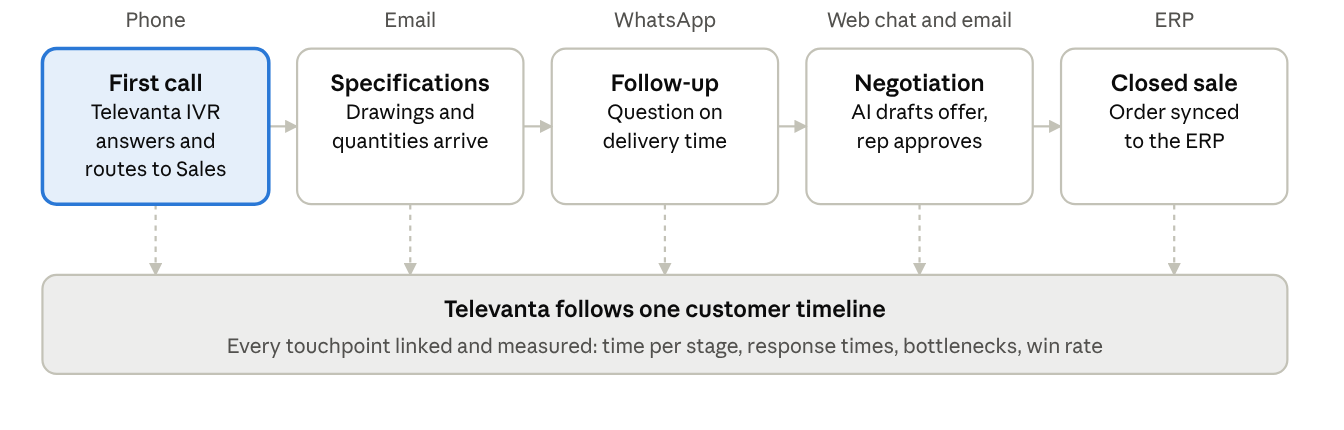
Televanta IVR is the front door: every later email, WhatsApp message and chat joins the same customer record, so management sees the whole path to the sale.
Here is how the lifecycle looks inside Televanta:
- 1. First contact through IVR or any channel. A call is answered and routed by Televanta IVR, or an inquiry arrives by email, web chat or WhatsApp. Televanta picks it up the moment it lands, transcribes calls and adds everything to one customer timeline, so nothing disappears into a personal inbox.
- 2. Understanding and routing. Televanta reads the message and any attachments, recognises the customer, the products and the intent, and judges urgency. It then routes the request to the dedicated rep for that account, market or product.
- 3. Offer preparation. Using prices, stock and past deals from your ERP and knowledge base, Televanta drafts the offer or reply. The sales rep reviews, adjusts and sends it. Nothing reaches a customer without human approval.
- 4. Negotiation to confirmed order. Every reply, call and change of terms is linked to the same deal, so the full story sits in one place. When the customer confirms, Televanta matches the order to the agreed offer and syncs it to the ERP, with no retyping.
- 5. Production and delivery tracking. Televanta keeps reading status from your ERP and team updates, shows the live stage of every order and flags those at risk of missing their date while there is still time to act.
- 6. Insight for management. Because Televanta has seen every step, it measures time per stage, workload per rep and win rates, and delivers reports, bottleneck alerts and AI recommendations.
Every channel feeds one tracked workflow and one management view
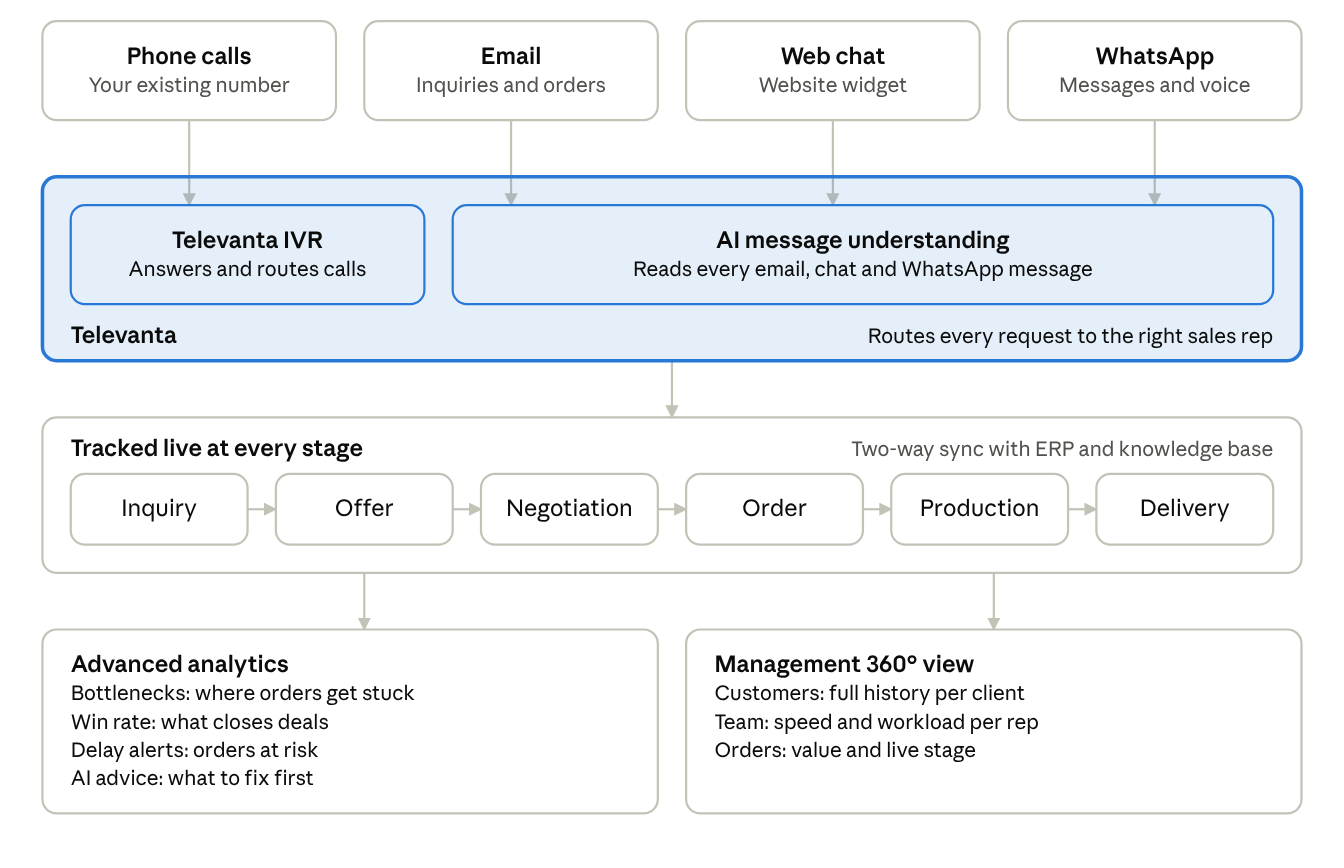
The result is a single, connected record of every deal across every channel. For the first time, the journey from the first "hello" on the phone to the signed order and final delivery is visible end to end.
Finding the bottlenecks: tracking and analysing the whole process
Most sales reports tell you what happened. Televanta's analytics are designed to tell you why it happened and what to change. Because the platform tracks every message, call and stage, it can answer the questions executives actually care about.
Where do deals wait longest? Bottleneck detection measures the time spent at every stage, broken down by customer, product and sales rep. Instead of a vague sense that "things are slow", you can see that, for example, the negotiation stage takes several times longer than the inquiry stage, and exactly how many days that costs per order.
What closes deals? Win-rate analysis compares won and lost offers by response time, discount level, product and rep. If deals that receive a first reply within two hours close significantly more often, that becomes visible, and it becomes a standard the team can work towards.
Which orders are at risk? Delay alerts flag orders that are likely to miss their date while there is still time to intervene, rather than after the customer complains.
What should we fix first? AI recommendations rank concrete actions by expected impact. A typical example: offers above a certain value wait much longer because they need a manager's price approval. Raising one experienced rep's approval limit could remove days from every large order. That is the kind of specific, measurable change that is almost impossible to spot without end-to-end data.
This is what turns AI sales automation from an efficiency tool into a management tool. The value is not only that work gets done faster, but that leadership can see precisely where the process breaks down.
Smarter decisions for the C-suite
With a complete view of the sales lifecycle, leadership can replace gut feel with evidence. Televanta's management 360° view brings customers, team and orders together in one live dashboard: the full history of every client across every channel, the speed, workload and results of every rep, and the value and current stage of every open order.
Different leaders use that view in different ways:
| Role | Key question | What Televanta shows |
|---|---|---|
| CEO and owners | Where should we invest to grow? | The whole commercial engine in one view: pipeline value, win rates and the stages that limit growth |
| COO and operations | Where does work stall between sales and production? | Time per stage, handover delays and orders at risk of missing delivery |
| Sales director | Is the team balanced and performing? | First-reply times, open deals, win rate and workload per rep |
There is also a strategic benefit that is easy to overlook. Because every interaction is captured in a shared knowledge base, the company's commercial know-how no longer lives only in individual inboxes. When people change roles or leave, prices, past deals and customer history stay with the business.
Integrated with your ERP, CRM and the rest of your stack
End-to-end visibility only works if the platform is connected to the systems that hold your commercial data. Televanta is built to sit on top of the tools your company already runs, not to replace them.
- Two-way ERP sync at every stage. Prices, stock and order data flow in both directions. Televanta uses ERP data to draft accurate offers, syncs confirmed orders back into the ERP without retyping, and keeps reading production and delivery status so every order shows its live stage.
- Live ERP data on every call. Through Televanta IVR, questions such as "Where is my order?" or "When will it ship?" are answered instantly from the ERP, at any hour.
- CRM integration. Televanta connects with CRMs such as HubSpot and Salesforce, so the full conversation history enriches the customer record instead of living in personal inboxes.
- Email, messaging and telephony. Gmail, Outlook and Microsoft 365, WhatsApp and SIP telephony connect directly, so every channel feeds the same customer timeline.
- Shared knowledge base. Product catalogues, price lists, FAQs and past deals form one knowledge base that both the AI and your team draw on.
- Any other system via API or MCP. Beyond the standard connectors, Televanta connects to other business systems through API or MCP, from in-house tools to industry-specific platforms.
For executives, integration is what turns AI from a side tool into part of the operating model. Data no longer has to be copied between systems, the numbers in management reports match the numbers in the ERP, and the sales team keeps working in the inbox, phone system and ERP it already knows.
Getting started: a practical roadmap for leadership
Adopting AI in sales does not have to be a large transformation programme. The most successful rollouts start small, prove value quickly and expand from there.
- Define the decisions you want to make better. Start with the questions leadership struggles to answer today: Why are deals slow? Where do we lose them? Is the team balanced? These become your first success metrics.
- Connect the channels you already use. Televanta works with the tools your team already has, including Gmail, Outlook and Microsoft 365, WhatsApp, SIP telephony and CRMs such as HubSpot and Salesforce, connecting through API or MCP. Your team keeps its inbox, phone system and ERP, and your existing phone number can simply be forwarded or ported to Televanta IVR.
- Run a short audit. Connect one mailbox for a limited period and let the platform build a first picture of your workflow, bottlenecks and team workload.
- Act on the first insights. Pick one or two recommended fixes, such as an approval limit or a rebalanced account list, and measure the effect over the following weeks.
- Scale across channels and teams. Add calls, web chat, WhatsApp and more mailboxes as the value becomes clear.
Governance matters too, especially for executives accountable for risk. Televanta is built to be GDPR compliant, keeps a human in the loop so nothing is sent to a customer without approval, maintains a full audit trail of every AI suggestion and action, and offers role-based access for management, reps and IT. Pricing is based on volume rather than seats, so adding managers or reviewers to the dashboard does not increase cost.
Conclusion: from gut feel to a data-driven sales engine
For years, the most important part of the sales process has happened where executives could not see it: in phone calls, inboxes and chat threads. AI sales automation workflows finally bring that activity into the light.
Televanta monitors the entire lifecycle, from the first call answered by Televanta IVR, or the first email, web chat or WhatsApp message, to the confirmed sale and delivery. It tracks and analyses every stage, shows management exactly where deals and orders get stuck, and recommends the changes most likely to make a difference. The outcome is a faster, more predictable sales operation, a fairer and better-balanced team, and leaders who make decisions based on evidence rather than instinct.
If you want to know where your own sales workflow slows down, the best first step is to see your data. Request a free workflow audit or book a demo and discover what a full view of your sales lifecycle can reveal.
Learn more: Televanta AI sales workflows and automations
Created on
Antonio Lupieri is an agentic AI leader at Televanta, where he helps businesses automate customer communication across phone, chat, WhatsApp and email. On the blog, he writes about AI voice agents, intelligent IVR, chatbots, WhatsApp bots and AI email assistants.