
When Europeans weigh up an AI phone agent, latency and voice quality are rarely what worries them. Their first three questions are plainer, and they decide the deal. Where does the call data go? Can we get a local number our customers will actually answer? Does the agent speak Polish, Czech or Dutch as well as it speaks English?
Many voice AI platforms were built for American callers first, and they work well there. Bring them to Munich, Warsaw or Rotterdam and those three questions start getting awkward answers.
This guide compares six alternatives on exactly those points, plus the channels and IVR features that decide how much of your customer service an AI can really take on. We build Televanta, so we have a stake here and we've put ourselves in the line-up. We've still tried to be straight about every platform, including where a competitor is the better pick. Every fact was checked against each vendor's own documentation.
The short answer
If you only read one paragraph, read this one. The right Retell alternative depends less on the AI and more on who will run it and which channels your customers use.
- Televanta suits European operators who want voice, email, web chat and WhatsApp agents in one place, plus an IVR upgrade, without hiring engineers. You keep your existing local number.
- Synthflow is a Berlin company with a true EU cluster. A good fit for no-code voice agents, as long as you don’t need WhatsApp or SMS from an EU workspace.
- Vapi fits developer teams who want an EU-hosted API and are happy to wire up their own model and speech providers.
- Parloa and PolyAI are for large enterprise contact centres with procurement teams, long timelines and custom budgets.
- ElevenLabs Agents is worth a look if voice quality is your top priority, but EU data residency is reserved for Enterprise customers.
Where Retell falls short in Europe
None of this makes Retell a bad platform. It makes it a US platform, and the gaps show up as soon as a European legal team or a local customer gets involved.
Your call data leaves the EU
Retell's own compliance page is clear about it: the company does not currently operate services within the EU. GDPR coverage comes from AWS's data processing terms and Retell's own DPA with Standard Contractual Clauses, which you self-sign.
That is legal under GDPR, which restricts transfers rather than demanding storage in Europe. But plenty of buyers need more than "legal". A hospital, an insurer or anyone covered by NIS2 often has a contractual requirement that recordings and transcripts stay in the EU. When a builder asked Retell's team about this, the reply confirmed that SCCs cover the legal basis for transfers but do not meet a physical EU residency requirement.
To be fair, Retell gives you useful controls. You can set retention per agent from one day to two years, scrub PII, or store nothing at all. Those help. They don’t move the servers.
You can't buy a European number
This one surprises people. Retell’s dashboard only sells US and Canadian numbers. Those numbers can call 15 countries, including Germany, France, Spain, Italy and the UK, at up to $0.10 a minute.
A German caller is not going to trust a call from a +1 number, though, and a Croatian clinic can’t put one on its website. For a local number you have to bring your own carrier over SIP: set up a trunk with Twilio or another provider, enable the right geographic permissions, then import the number. Developers manage that fine. An operations manager at a hotel group usually doesn’t want to.
Languages are broad, but the stack is yours to tune
Retell advertises 55+ languages at one per-minute rate, with no surcharge for non-English calls. That’s a real strength. The catch is that quality in smaller European languages depends on which speech, voice and language model you pick, and picking well is your job. Choose a model with weak Slovenian and your agent will have weak Slovenian.
How we compared them
We looked at six platforms that European teams most often shortlist when they leave Retell. Each was judged on five questions, the same ones a procurement team will ask you:
- Data: Can call data be stored and processed inside the EU, and on which plan?
- Numbers: Can you get a local European number, or keep the one you have, without a telecoms project?
- Languages: How many languages, and are smaller EU languages realistic?
- Channels: Is the agent stuck on the phone, or can it follow the customer into chat, WhatsApp and email?
- IVR: Does it replace or improve your phone menu, or only navigate other people's?
We used public documentation only. Pricing for most of these vendors is custom, so we've left price comparisons out rather than guess.
Retell AI vs the alternatives at a glance
No platform wins every row. The pattern is that EU data residency is now common, while local numbers, messaging channels and a ready-made IVR are where the differences really sit.
| Platform | EU data | Local EU numbers | Languages | Channels | IVR |
|---|---|---|---|---|---|
| Retell AI | No EU services; SCCs + DPA | Bring your own via SIP | 55+ | Voice, SMS, web chat | Conversational routing; keypad navigation on outbound calls |
| Televanta | GDPR-compliant, strict tenant isolation, full audit trail | Keep your existing number on any SIP carrier | 30+, incl. German and Croatian | Voice, email, web chat, WhatsApp | Intelligent IVR: keypad menu with a specialist AI agent behind each option |
| Synthflow | EU cluster: storage and compute in the EU | Buy US, CA or AU; import via SIP on Enterprise | Up to 60 for speech recognition | Voice, web chat; WhatsApp and SMS in US workspaces only | Build it in the flow designer |
| Vapi | EU region in Frankfurt; default AI providers may route to the US | Import over SIP to the EU endpoint | Depends on the providers you choose | Voice, web chat, SMS via Twilio | Build it yourself |
| Parloa | German data residency; regional Parloa Zones | Through your contact-centre telephony | 35+ | Phone, chat, messaging | Enterprise project with the vendor |
| PolyAI | GDPR; EU residency on enterprise tiers | Through your telephony or PolyAI-managed numbers | 45 | Voice, web chat, SMS, WhatsApp | Enterprise project with the vendor |
| ElevenLabs Agents | EU residency on Enterprise only | Import via Twilio or SIP | 90+ voice languages | Phone, web, app, WhatsApp | Not a packaged product |
As of November 2026, from each vendor’s public docs.
AI agents: who builds them, and who keeps them right
Every platform on this list can put a capable language model on a phone line. The models are mostly the same ones. What differs is who does the building, and what stops the agent from making things up.
Developer-first platforms (Retell, Vapi). You get APIs, webhooks and a flow builder, and you choose the model, the speech-to-text and the voice. That freedom is great if you have engineers. It also means the European pieces are your problem. Vapi’s own support team says that for full EU residency across the stack you should bring your own provider keys, because default providers such as OpenAI may route data to US endpoints.
No-code builders (Synthflow, ElevenLabs Agents). Faster to start, and both have strong voices. Your ops team can usually maintain the agent once it’s live. The limits show up in the details, like which channels work in which region.
Managed enterprise platforms (Parloa, PolyAI). The vendor’s team does much of the design and testing with you. Quality is high and so is the commitment: no public pricing and launches measured in weeks or months.
Televanta sits between the last two. Behaviour is written in plain language rather than code, and every answer is grounded in your own documents through retrieval, so the agent quotes your policy rather than guessing. When it doesn’t know, it hands over to a person. It connects to HubSpot, Salesforce, Gmail, Microsoft 365 and ERP or booking systems through API or MCP, so it can check an order or move a booking, not just talk about one.
Two details matter more in Europe than they first appear. Televanta doesn’t lock you into a single AI provider, so you can pick models that meet your own data rules. And there’s an option to require human approval before a message goes out, with a full audit trail of drafts, edits and sends. Compliance teams like being able to show that.
Communication channels: the phone is only half the conversation
A customer rarely stays on one channel. They call about a delayed delivery, get a confirmation by WhatsApp, then reply to an email two days later. If each of those is a different system, nobody has the full story, least of all the AI.
In Europe the channel that matters most after the phone is WhatsApp, and it’s also where the platforms differ most:
- Retell does voice, SMS and web chat agents. We couldn’t find native WhatsApp or email in its documentation, and its own community forum has a feature request asking for them.
- Synthflow has WhatsApp and SMS chat agents, but its docs state they’re available only in US workspaces. An EU workspace gets API and widget chat. That’s a real trade-off for a European team that picked Synthflow for its EU cluster.
- Vapi added SMS chat, but it runs on Twilio only and needs a 10DLC-approved number, a US registration scheme. The assistant also can’t send the first message.
- PolyAI and ElevenLabs Agents both cover web chat and WhatsApp alongside voice, and PolyAI adds SMS. Both are strong here.
- Televanta runs four channels on one customer record: voice, email, web chat and WhatsApp. A conversation that starts on the phone can carry on in a message without the customer explaining it again. The WhatsApp agent handles inbound replies and outbound campaigns, and the email agent works inside Gmail and Microsoft 365.
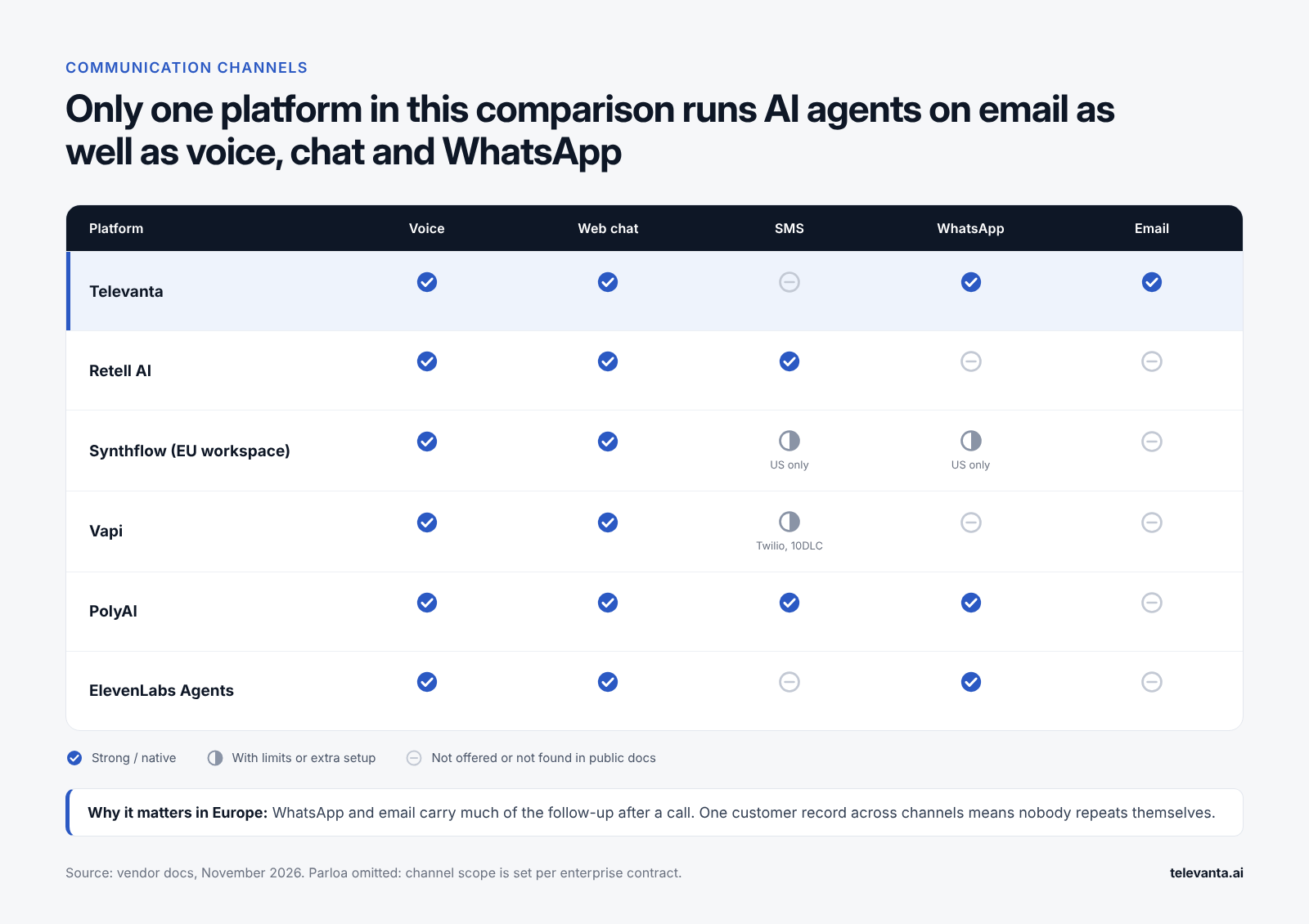
Email deserves a special mention. In many service teams it’s the slowest queue of all, yet it’s the channel the developer-first voice platforms ignore. If your inbox is as full as your phone queue, check this row first.
IVR: replacing "press 1" without throwing it away
IVR is where a lot of comparisons get muddy, because "AI IVR" means three different things depending on who’s selling it.
The first is an agent that navigates other companies’ menus. Retell’s Press Digit tool is built for this: on an outbound call, the agent presses keypad digits to get through a supplier’s or insurer’s menu. Useful, but it does nothing for your own callers.
The second is a conversational front door that asks callers why they’re calling and routes them on intent, with no menu at all. Retell’s AI IVR page describes this, and it’s what PolyAI and Parloa build for large contact centres. It works well when it’s tuned. When it isn’t, callers repeat themselves to a machine that keeps guessing.
The third is what we built at Televanta, and we think it suits most European operators better. Callers still hear a short, familiar menu. Behind each option sits a specialist AI agent that handles one topic only: bookings, billing, technical support. Because each agent has a narrow job, it’s more accurate, easier to update, and easy to report on by topic.
How it plays out on a real call:
- The caller presses 2 for billing, or simply says what they need.
- The billing agent answers in the caller’s language and pulls live data from your ERP or billing system.
- If the queue for a person runs past about three minutes, the caller is offered a callback. After hours, the agent books one for the next day.
- Pressing 0, or saying “I’d like to speak to someone”, reaches a person at any point. Complaints, injuries or upset callers can be routed to a human automatically.
- The person who picks up gets the transcript and a summary, so nobody starts from scratch.
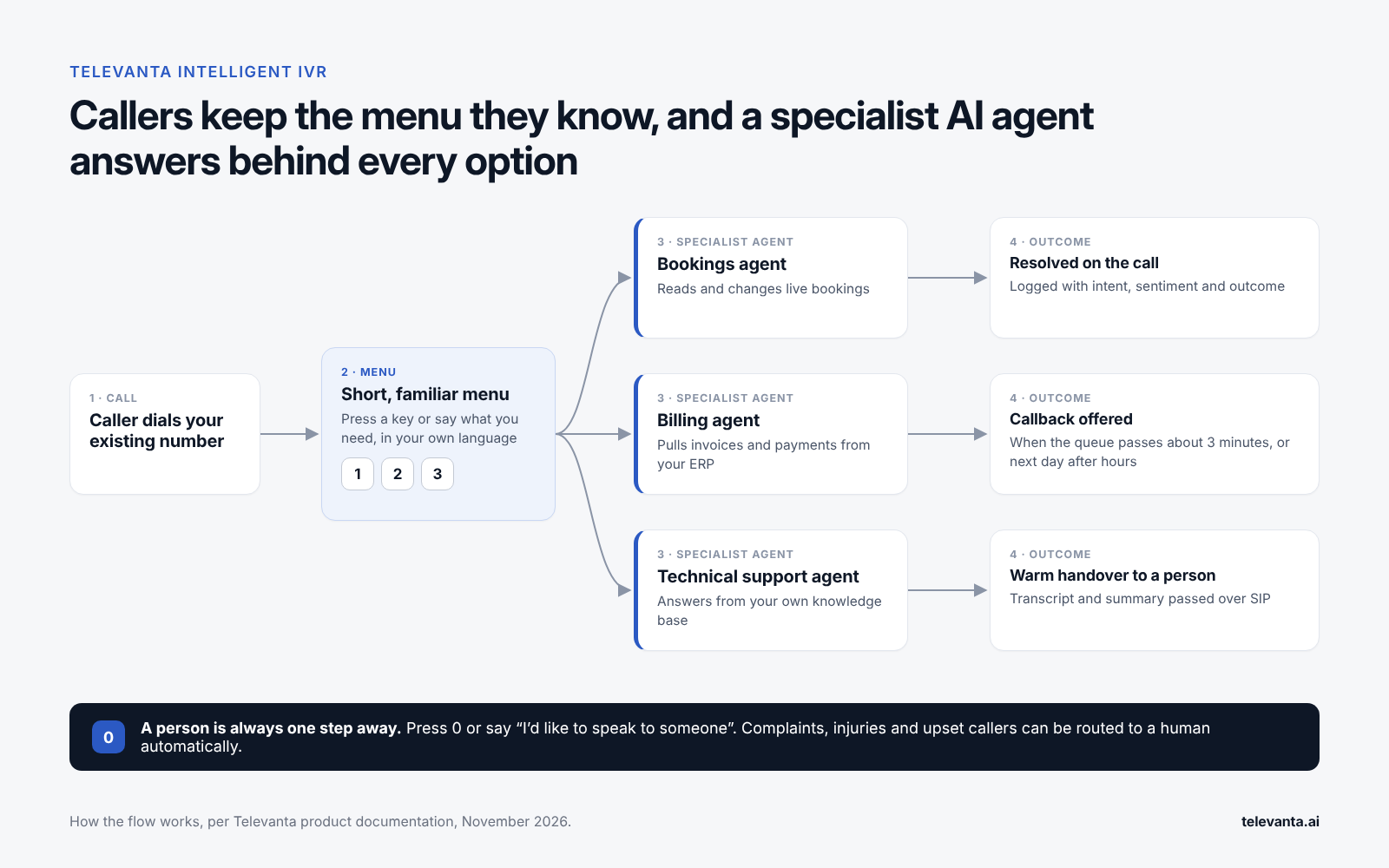
You keep your existing number and menu structure, and you approve what the AI says before callers hear it. For a team that has spent years training customers to “press 3 for reservations”, that continuity matters.
The six alternatives, one by one
Televanta
An AI communication platform for voice, email, web chat and WhatsApp, with an Intelligent IVR on top. It’s built for operators rather than developers: healthcare, hotels, telecom, insurance, aviation and customer support teams, each with pre-built playbooks. Agents speak 30+ languages, including German and Croatian, and pick up in under two seconds. Most teams start with a 14-day pilot on one use case.
Worth knowing: Televanta is the conversation layer, not a full contact-centre suite. If you also need workforce management, you'll run it alongside your existing CCaaS.
Synthflow
Berlin-based and run by AgentFlow AI GmbH, Synthflow offers three clusters, and its EU cluster keeps both storage and compute in the EU. It's no-code and quick to get going.
Worth knowing: cluster choice is permanent once a workspace exists. You can only buy US, Canadian or Australian numbers directly, and importing your own number over SIP needs an Enterprise account.
Vapi
A developer platform with a dedicated EU region in Frankfurt: separate dashboard, API and SIP endpoints. Excellent if your engineers want full control.
Worth knowing: the EU region is a separate account environment, and true end-to-end residency means configuring EU-hosted model, transcription and voice providers yourself.
Parloa
A Berlin enterprise platform for large contact centres, with Parloa Zones to prove data residency region by region. Strong governance, testing and simulation.
Worth knowing: no public pricing, no self-serve plan, and it's sized for enterprises. A 20-person operation will likely find it more than it needs.
PolyAI
London-based and known for some of the most natural-sounding phone agents around. It runs agents across voice, web chat, SMS and WhatsApp, and supports 45 languages as standard.
Worth knowing: PolyAI is services-led with custom pricing. Expect a proper project rather than a quick start.
ElevenLabs Agents
The voice quality you'd expect from ElevenLabs, with one agent deployable across phone, web, mobile apps and WhatsApp.
Worth knowing: customer data is stored in the US by default. EU data residency is an Enterprise-only feature, so smaller teams don't get it.
Where Televanta fits, and where it doesn't
We'd rather you pick the right tool than pick us and regret it. So here's the honest version.
Televanta is a strong fit if:
- You serve customers in more than one European language and need the smaller ones, like Croatian, to sound as natural as English.
- You want to keep your current local number and phone menu, not buy a US number or rebuild your telephony.
- Calls are only part of the load and your WhatsApp and email queues need help too.
- Operations, not engineering, will own the agent day to day.
- Your compliance team wants tenant isolation, human approval before messages go out, and an audit trail they can show a regulator.
Look elsewhere if:
- You have a strong engineering team that wants to assemble every component itself. Vapi or Retell will give you more knobs.
- You're a very large enterprise that needs a full contact-centre suite with workforce management in one contract. Parloa or a CCaaS vendor's own AI may fit better.
- Your callers are almost all in the US. Retell's managed US numbers and pricing are hard to beat there.
Seven questions to ask any vendor before you sign
Whichever platform you shortlist, put these to the sales team in writing. Vague answers tell you a lot.
- Where are recordings, transcripts and logs stored, and where does live processing run? Ask about the model, speech-to-text and voice providers too, not just the database.
- Is EU residency included on our plan, or only on Enterprise?
- Can we keep our existing number, and which countries can we buy new numbers in?
- Which channels work in an EU-hosted workspace? Ask specifically about WhatsApp and SMS.
- How is our data kept separate from other customers'?
- What happens when the agent doesn't know the answer?
- Can we see a test call in our smallest language before we commit?
The last one is the cheapest test there is. Ten minutes on the phone in Slovak or Croatian will tell you more than any spec sheet.
FAQ
Is Retell AI GDPR compliant?
Retell says yes, through AWS's data processing terms and its own DPA with Standard Contractual Clauses. What it doesn't offer is EU-hosted infrastructure, so it may not meet a contract or tender that requires data to stay in the EU.
Does GDPR require EU data residency?
No. GDPR restricts transfers out of the EU and allows them with safeguards such as SCCs. Residency becomes a must when a contract, a public tender, a sector rule like NIS2 or your own risk assessment demands it.
Can I use a German, French or Croatian number with Retell?
Not by buying one in Retell. You'd buy it from a carrier and connect it over SIP. With Televanta you connect the number you already have on any SIP carrier.
Which Retell alternative supports WhatsApp in Europe?
Televanta, PolyAI and ElevenLabs Agents all offer WhatsApp agents. Synthflow does too, but only in US workspaces.
What's the difference between an AI IVR and a regular IVR?
A regular IVR routes callers to a queue. An AI IVR answers the question itself. Televanta keeps the menu callers know and puts a specialist AI agent behind each option, with a person always one keypress away.
How long does it take to switch from Retell?
With Televanta, most teams run a 14-day pilot on one use case, and a typical rollout takes about a week.
The bottom line
If your only problem with Retell is that the servers are in the US, several alternatives now fix that. Synthflow, Vapi, Parloa and ElevenLabs all have an EU story, with different strings attached.
Most European teams have a bigger problem, though. Their customers call from local numbers, write on WhatsApp, chase things by email, and expect a reply in their own language. That's the problem Televanta was built for: one platform across voice, email, chat and WhatsApp, an IVR that answers rather than just routes, and your existing number left exactly where it is.
The quickest way to find out is to hear it. Book a 20-minute demo and we'll put a live call through in your language.
Created on
Antonio Lupieri is an agentic AI leader at Televanta, where he helps businesses automate customer communication across phone, chat, WhatsApp and email. On the blog, he writes about AI voice agents, intelligent IVR, chatbots, WhatsApp bots and AI email assistants.