- AI chatbots
- 10
- Languages
- 30+
- Average reply time
- <1.5 s
- Calls
- 24/7
The chatbot question has changed
For any business today, the chatbot conversation sounds very different from what it was not long ago. Back then the question was whether a bot could deflect a few easy tickets. Now the question is which AI agent can actually solve a customer's problem on your website at 2 a.m., in the customer's own language, without making anything up.
The shift is real, and the numbers back it up. Salesforce's latest State of Service research found that adoption of AI agents in customer service organizations jumped from 39% to 66% in a single year. Pricing has moved as well. Several vendors on this list now charge per resolved conversation instead of per seat, which tells you how confident they have become about what their bots can finish on their own.
This guide ranks the ten AI chatbots we think deserve a place on your shortlist right now. Televanta takes the top spot, and we spend the most time on it, because it does something most tools here only partly do: it treats the web chat, the phone line, email and WhatsApp as one conversation built on one knowledge base. After the ranking you'll find a practical way to choose between them.
Why the web chatbot still matters most
Every channel counts, but your website is where intent runs highest. A customer who opens your pricing page, your returns policy or your booking form is already halfway to a decision. If a question comes up at that moment and the only options are a contact form or a phone queue, a good share of those people simply leave. A web chatbot is the one tool that meets them right there, on the page, while the intent is still warm.
We would put the web chatbot at the center of any customer service automation plan for four reasons.
It's available when your team isn't. Most questions don't arrive during office hours. Evenings, weekends and holidays are when people finally have time to shop, compare plans or sort out a billing problem. A good chatbot answers at 11 p.m. on a Sunday with the same quality it delivers at 10 a.m. on a Tuesday.
It's the cheapest place to resolve a contact. A question answered in chat never turns into a phone call, a long email thread or a ticket that bounces between three agents. Every resolution there frees your people for the conversations that genuinely need judgment and empathy.
It captures demand, not just complaints. A web chatbot doesn't only handle support. It can greet a visitor on a pricing page, explain a feature, qualify the lead and book a demo. For many companies the chatbot quietly becomes one of the better performing sales assistants on the team.
It shows you what customers really ask. Chat transcripts are one of the most honest sources of customer insight you will ever get. They reveal which policies confuse people, which pages fail to answer questions and where your product creates friction. Teams that read their chatbot analytics every week tend to fix root causes faster.
The catch is simple. A web chatbot is only as good as the answers it gives. A bot that guesses, loops or forces people through a rigid menu does more damage than having no bot at all. That is why the knowledge base behind it matters so much.
Televanta
Televanta earns the top spot because it solves the problem that frustrates businesses and their customers most: customers bouncing between channels and repeating themselves every time they switch. Televanta is an AI communication platform that answers calls, emails, web chats and WhatsApp messages around the clock in more than 30 languages. Its web chatbot sits at the center of that system rather than off to the side as a separate tool.
A web chatbot built for real conversations
The Televanta Chatbot Agent does two jobs at once on your website. It resolves common questions instantly, at any hour, and it helps convert visitors who are close to buying. Replies are written by a large language model, but they are grounded in your own instructions, policies and connected data, and the agent is built to stay within its scope instead of inventing answers. Televanta reports an average reply time under 1.5 seconds, which matters more than it sounds. In chat, a pause of a few seconds feels like being ignored.
You also get fine control over how the bot behaves. Each page or campaign can carry its own greeting, and the tone can be set to formal, casual, technical or sales focused. A visitor reading your pricing page can be met by an agent tuned for buying questions, while someone on a support page meets an agent focused on troubleshooting, each with its own persona, knowledge and language. Proactive prompts can open a conversation based on visitor behavior, exit intent or a visit to the pricing page, so the chatbot starts helping before the customer gives up and closes the tab.
One knowledge base for every channel
Every chatbot is only as reliable as the knowledge behind it. A knowledge base is the approved content the bot is allowed to draw from: help center articles, FAQs, product documentation, policies, price lists and internal procedures. When a customer asks something, the system searches that content, pulls the passages that apply and writes a natural reply grounded in them. Done well, the customer gets a specific, correct answer in seconds. Done badly, the bot fills the gaps with confident guesses, and your team spends the next week cleaning up.
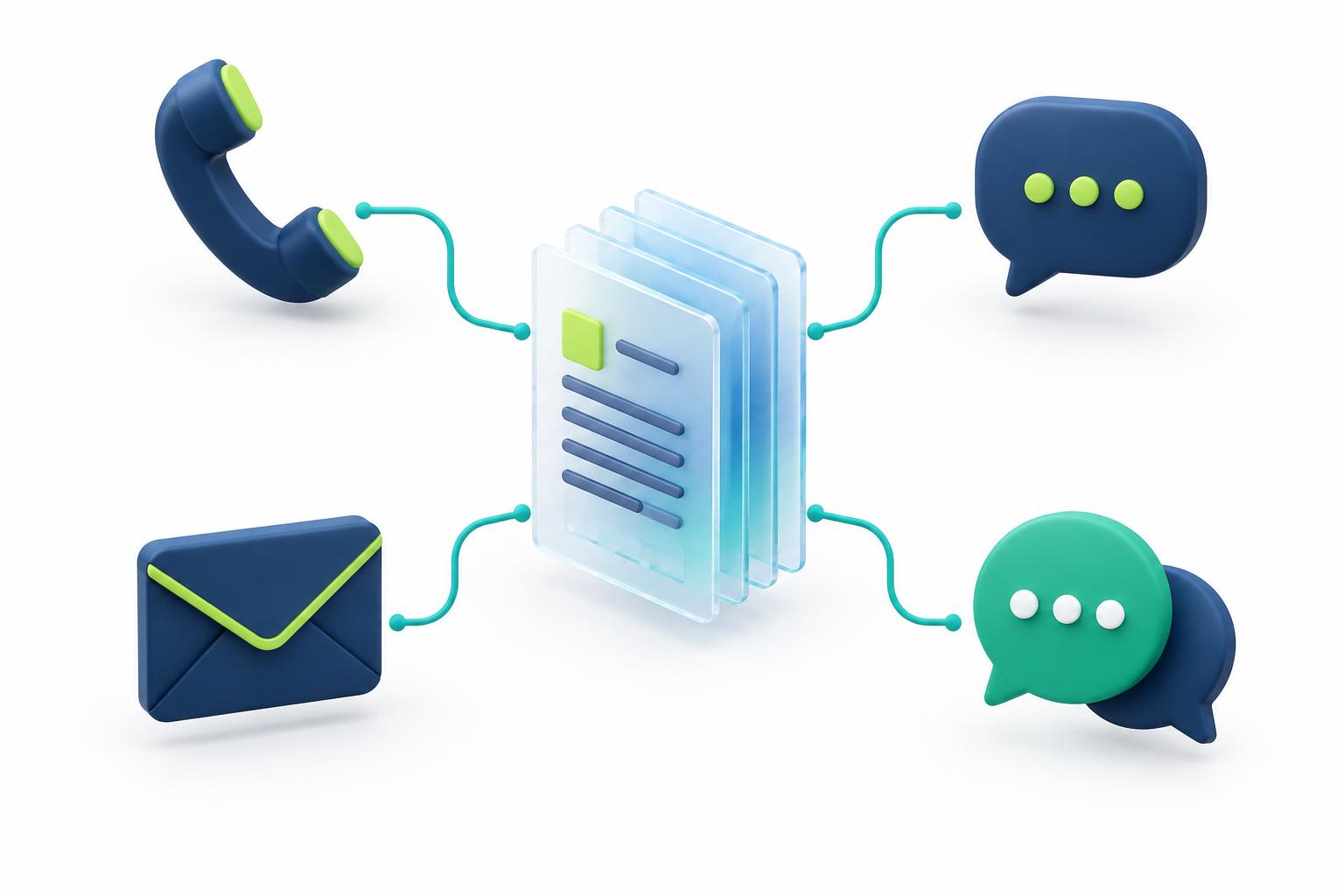
This is where Televanta pulls ahead of the pack. Instead of building separate content for the chatbot, the phone agent and the email assistant, you upload your internal documentation once and every agent answers from it first. Televanta connects to your website, documents and FAQs, so the knowledge base reflects what you already publish, and you don't need engineers or retraining to get started.
The practical result is consistency. A customer who asks about your cancellation policy in chat on Monday and calls about it on Wednesday hears the same answer both times. For any business, that removes one of the most common causes of complaints and escalations: two channels telling the same customer two different things.
Televanta also takes care of the parts of knowledge management that usually trip teams up. Content gets in without engineering work, because the platform connects to your site, documents and FAQs and can answer from them without manual uploads. When the answer simply isn't there, the agent doesn't invent one. It stays within its scope and hands the conversation to a person with the full history attached. That combination is what turns a knowledge base into automatic answers you can trust: routine questions get resolved on their own, day and night, and your team only sees the conversations that truly need them.
Automatic answers that lead to action
Automatic answers are only half of a resolution. The other half is actually doing something about the request. Televanta connects to CRM, calendar and scheduling, payment and helpdesk systems through API or MCP, so the chatbot can book a meeting, qualify a lead, check a booking or update a record instead of just explaining how the customer could do it. In hospitality, for example, Televanta checks and changes reservations against live availability. In telecom, it plugs into billing, network and ticketing systems so each subscriber is verified and served against their real account data.
High intent leads are routed to your sales team automatically. When a conversation needs a person, the handoff carries the full history with it. Because the chatbot works from the same customer record as the call, email and WhatsApp agents, nothing gets lost along the way and nobody has to ask the customer to start over.
From chat to voice in one click
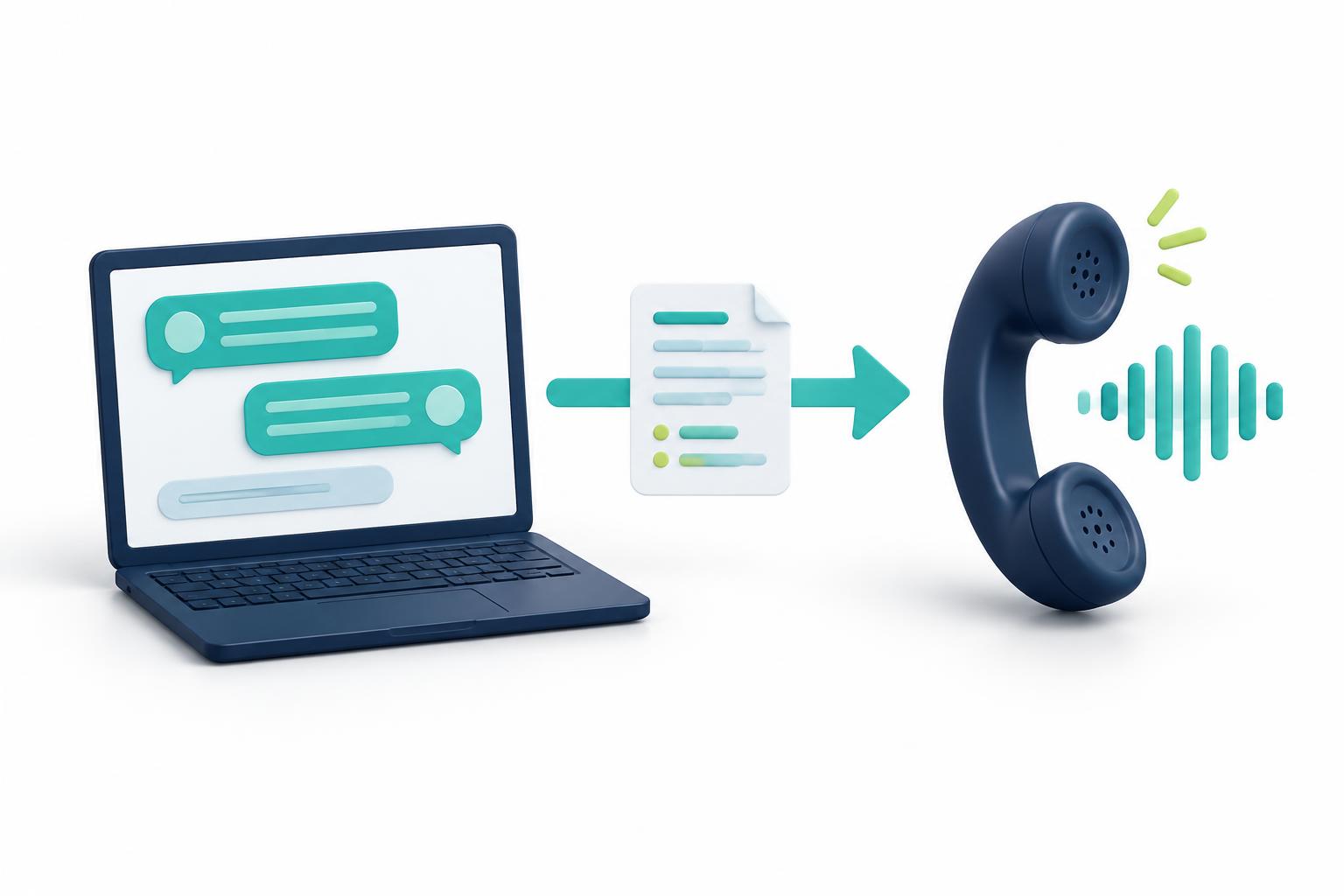
One feature stands out in particular: visitors can switch from the web chat straight to an AI call agent, with no queue. Some customers simply prefer to talk, especially when the issue is stressful or complicated. Televanta lets them move from typing to speaking without starting again, and the voice agent already knows what was said in the chat.
Voice is a core part of the platform, not an add on. The Televanta call agent answers and handles calls 24/7, remembers context, asks follow up questions and copes naturally when a caller interrupts. Around it, Televanta offers an email assistant, a WhatsApp agent, an IVR and sales workflow automation, all sharing the same knowledge and the same customer history.
Visibility you can actually use
Every chat is summarized automatically with intent, sentiment, outcome and a full transcript. The dashboard shows containment rate, chat volume, CSAT and a seven day volume trend, and it lets you compare agents by chats handled, average duration and satisfaction. That gives you the evidence you need for a quarterly business review. More importantly, it shows you exactly which questions the knowledge base still can't answer, so you know what to fix next.
Built for regulated, high volume industries
Televanta works with healthcare providers, hotels, insurance companies, retailers, telecom operators, municipalities and aviation businesses. These are organizations that handle large volumes of inbound contact and can't afford careless mistakes. The platform is GDPR compliant and offers a HIPAA ready healthcare playbook as well as PCI compliant conversation flows for billing. Unlike platforms that tie you to a single AI provider, Televanta gives operators control over their AI stack and their deployment model, which matters to IT and compliance teams just as much as it does to customer service.
Why it's our number one
Plenty of tools on this list can answer questions in a chat window. Televanta is the one that treats the website, the phone, the inbox and WhatsApp as a single connected service built on one knowledge base. Teams can go live in days rather than months, and customers get the same quality of help wherever they start. If your goal is to raise automatic resolution without lowering the quality of the customer experience, Televanta is the right place to begin your evaluation.
Best for: Businesses of any size that want a web chatbot that shares one knowledge base and one customer record with voice, email and WhatsApp, especially in healthcare, hospitality, telecom, insurance, travel and retail.
Fin (formerly Intercom)
Fin is the AI agent that made Intercom famous, and it has now become the company's identity. Intercom renamed itself Fin, and Salesforce has since completed its acquisition of the business. The product remains one of the most capable support chatbots available. Fin answers from a connected knowledge base, can call tools to take actions, and works across chat, email and voice. Fin reports an average resolution rate of 76% across its customers, a vendor figure rather than an independent benchmark.
Pricing is outcome based at $0.99 per resolution, and Fin can run on top of other helpdesks such as Zendesk and Salesforce, not only inside the Intercom inbox. That flexibility is a real strength. The trade off is predictability: as your resolution rate climbs, so does your bill, which can surprise a finance team. It's also worth watching how the roadmap develops now that Fin sits inside Salesforce next to Agentforce.
Best for: Digital first SaaS and ecommerce companies that want a proven support agent and are comfortable paying per resolution.
Zendesk AI agents
Zendesk has spent recent years turning itself from a ticketing tool into what it calls a Resolution Platform. Its newest lineup, branded the Autonomous Service Workforce, is a set of specialized AI agents that work across messaging, email, voice and back end systems. The platform is trained on roughly 20 billion ticket interactions and uses what Zendesk calls a Resolution Learning Loop to spot knowledge gaps and improve answers over time. Zendesk also acquired Forethought to strengthen its self learning agents.
The pricing model deserves a mention. Zendesk charges on outcomes and says every billed resolution is checked by a separate AI evaluation model, which answers a common worry about vendors grading their own homework. If your team already runs on Zendesk, the native connection to your help center, macros and reporting is hard to beat. If it doesn't, adopting the full platform is a bigger commitment than adding a standalone chatbot.
Best for: Support teams already on Zendesk that want AI agents tightly tied to their existing help center and workflows.
Salesforce Agentforce Service
Agentforce Service is the new name for Service Cloud, and it brings AI agents directly into the CRM that many large enterprises already depend on. Salesforce recently added Agentforce Help Agent, a preconfigured service agent with guided setup across Salesforce Knowledge, CRM data, uploaded files and websites, along with pay per resolution pricing. Salesforce runs it on its own help site and says it has handled 4.3 million customer inquiries there, resolving 70% of them without a human.
The big advantage is context. Because the agent sits on top of your customer data, it can personalize answers and act on orders, cases and accounts without extra integration work. The disadvantage is weight. Agentforce rewards companies that already have a mature Salesforce setup and an admin team to configure it. With Fin now under the same roof, Salesforce effectively offers two paths: Fin for faster deployment and Agentforce for deep enterprise customization.
Best for: Large enterprises already invested in Salesforce that want AI agents working directly on their CRM data.
Sierra
Sierra was founded by Bret Taylor, who once ran Salesforce alongside Marc Benioff, and Clay Bavor, a longtime Google executive. It has quickly become the name big brands mention when they talk about premium AI customer experiences. In its latest funding round it raised $950 million at a valuation above $15 billion, and it says it serves around 40% of the Fortune 50. Its Agent OS powers chat and voice conversations for companies in financial services, healthcare, retail and travel.
Sierra's agents are known for their warmth and strong brand voice. Tools such as Ghostwriter let teams build an agent from written procedures, call transcripts or a goal described in plain English. The model is high touch: Sierra works closely with each customer to design and tune the agent, and pricing is negotiated rather than published. That produces polished results but puts Sierra out of reach for most smaller budgets.
Best for: Large consumer brands that want a premium, highly customized AI agent and have the budget for a hands on partnership.
Decagon
Decagon is one of the most talked about AI support startups of the moment, valued at $4.5 billion in its most recent round. Its customers include Notion, Duolingo, Chime and Hertz. Decagon agents work across chat, email, voice and SMS and handle complete conversations, from answering product questions to processing refunds and cancellations.
What sets Decagon apart is how much control it gives over behavior. Its Agent Operating Procedures let you describe workflows in natural language, so operations staff can shape how the agent handles a refund or an account change without writing code. Tools for testing, tracing and debugging make it easier to understand why the bot did what it did. Like Sierra, Decagon is sales led with custom pricing, so expect an enterprise style buying process.
Best for: High volume consumer and fintech brands that want deep workflow control and are ready for an enterprise contract.
Ada
Ada has worked in customer service automation for about a decade, well before generative AI went mainstream, and it has rebuilt its platform around modern AI agents. Its unified Reasoning Engine means the same knowledge, policies and brand standards apply whether a customer reaches out by voice, messaging, social or email. Ada supports more than 100 languages and was the first platform of its kind to earn certification under an AI safety standard written specifically for customer service agents.
Ada works as an agent layer next to your existing helpdesk rather than replacing it, and it gives teams coaching tools, simulations and performance reporting to improve the agent over time. That makes it a strong fit for global enterprises with complex, multilingual operations. Smaller companies may find the setup and pricing more than they need.
Best for: Global enterprises that need consistent automation across many languages and channels.
HubSpot Customer Agent
For companies that run marketing, sales and service on HubSpot, the Customer Agent is the most natural choice. It answers support conversations from your HubSpot knowledge base and other connected sources, works across chat, email and messaging channels, and passes conversations to your team inside the same inbox. HubSpot says the agent resolves around 65% of conversations on average and cuts resolution time by 39%, based on data from more than 8,000 customers.
Under its current pricing, messaging costs $0.50 per resolved conversation, one of the lowest per resolution prices on this list. You do need a Professional or Enterprise HubSpot subscription. The agent shines on routine, information based questions. For complex workflows that reach into systems outside HubSpot, it's less flexible than the dedicated AI agent platforms.
Best for: Small and midsize businesses already on HubSpot that want an affordable, native support agent.
Freshworks Freddy AI Agent
Freddy AI Agent is the customer facing chatbot inside Freshdesk and Freshchat. You build it in a no code workspace called AI Agent Studio by adding knowledge sources, setting a persona and instructions, and assigning the agent to channels such as web chat and WhatsApp. Freshworks has reported that more than 8,000 customers use Freddy AI.
The appeal is simplicity and price for teams already on Freshworks. Billing is session based, with a number of sessions included and extra packs available, so high volume teams should model their costs carefully. Independent reviewers generally rate Freddy well for FAQ style automation and agent assistance, but less advanced than specialist platforms when it comes to complex, multistep actions.
Best for: Midsize support teams on Freshdesk that want straightforward automation without adding another vendor.
Tidio Lyro
Tidio has long been a favorite among small businesses and online stores, and Lyro is its conversational AI agent. Lyro learns from the content you give it, such as FAQs, website pages and imported help center articles, and answers in your brand's voice through the web chat widget, email, Facebook Messenger and Instagram. Tidio says Lyro can solve up to 67% of customer problems in seconds, and Lyro is now also available as a standalone agent for Zendesk and Salesforce.
Getting started is easy, and every account gets 50 free Lyro conversations to try it out. As volume grows, conversation based pricing and separate charges for seats and automation flows can add up, so check your projected numbers before you commit. For a Shopify or WooCommerce store that wants a capable website chatbot this week, Lyro is a sensible place to start.
Best for: Small and midsize online stores that want a quick, affordable web chatbot.
How to choose the right AI chatbot
A ranking is a starting point, not a decision. Before you sign anything, work through these questions with your team.
Where do your customers actually start? If most journeys begin on your website, the quality of the web chat experience should carry the most weight. If a large share of customers still call, give priority to a platform where the chatbot and the voice agent share the same knowledge and history.
How healthy is your knowledge base? Every vendor will tell you their AI is accurate. In reality, accuracy depends on your content. Review your help center and policies before the pilot, and pick a tool that makes it easy to connect, update and test that content.
What should the bot be able to do? Answering questions is the baseline. Decide which actions matter most, such as booking, rescheduling, refunds, order tracking or lead qualification, and confirm that the platform connects to the systems involved.
How will you measure success? Agree on a short list of metrics before launch: automatic resolution rate, satisfaction scores for conversations the bot handled, time to resolution, and the share of handoffs that arrive with full context. Ask each vendor how they define a resolution, because the definitions vary a lot.
What will it cost at scale? Pricing per resolution, per session and per seat all behave differently as volume grows. Model the cost for your busiest month, not an average one.
Who owns it after launch? The best results come from teams that read transcripts, close knowledge gaps and adjust instructions every week. Make sure someone on your team has that job.
Run a pilot on real traffic for a few weeks, ideally on one busy page or topic, and compare the results with your current baseline. The numbers will tell you far more than any sales demo.
Final thoughts
Customers no longer compare your service only with your direct competitors. They compare it with the best experience they have had anywhere. A web chatbot that answers instantly, draws on a clean knowledge base and knows when to bring in a person is one of the most effective ways to meet that standard without growing your team at the same pace as your contact volume.
Every platform on this list can help, and the right choice depends on your systems, your size and your customers. If you want one connected service where the web chatbot, the phone line, email and WhatsApp all share one knowledge base and one customer history, Televanta is the one we would put at the top of your shortlist.
Created on
Antonio Lupieri is an agentic AI leader at Televanta, where he helps businesses automate customer communication across phone, chat, WhatsApp and email. On the blog, he writes about AI voice agents, intelligent IVR, chatbots, WhatsApp bots and AI email assistants.