What Is an AI Call Agent? A Complete Guide with Real-World Examples
- 11 de mayo
- 6 min read
Actualizado: hace 3 días
Most people have already talked to an AI call agent without knowing it. They called a business, got an answer within two seconds, had their question handled, and hung up.
No hold music. No "your call is important to us." Just a resolved call.
That's the end state. Here's everything that sits behind it.
What an AI Call Agent Actually Is
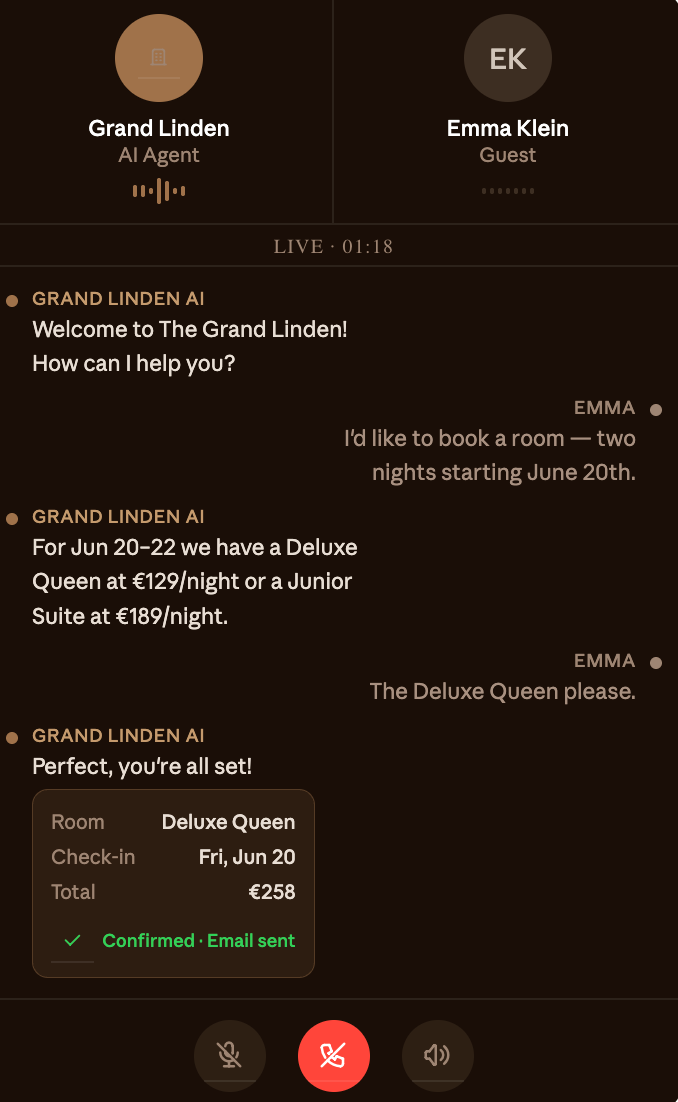
An AI call agent is a system that answers or places phone calls, holds a natural conversation, and takes action, without a human on your end involved. It's not a phone tree that routes you through numbered options. It's not a voicemail dressed up with a friendly script.
When someone calls, they're talking to something that listens, understands what they're asking, and responds in context.
Three components make this work:
The first is the AI model, the reasoning layer that interprets what a caller says and decides how to respond. This is what separates an AI call agent from older IVR systems. Instead of matching a caller's input to a fixed menu option, the model understands intent, even when the caller phrases things in an unexpected way.
The second is memory. A call agent needs to track what's been said across the entire conversation. Without it, every exchange would start from scratch. A caller who says "I want to move my appointment to Thursday" would get no useful response from a system that didn't remember they had an appointment at all.
The third is tools, the connections that let the agent actually do something in the real world: check a calendar, confirm availability, book a slot, look up account information, or transfer the call with the conversation history already attached.
The voice layer wraps all of this. A caller speaks, their words are transcribed into text, processed by the AI, and the response is converted back into natural-sounding speech. From the caller's side, it sounds like a conversation. From the business's side, it's a handled call.
Why Businesses Are Deploying These Now
Phone calls have not declined the way people predicted. In healthcare, home services, legal, hospitality, and retail, the phone is still how customers take action when the decision is made.
The BrightLocal 2023 Local Consumer Review Survey found that 60 percent of consumers prefer to call a local business directly when they're ready to buy or book.
The problem is coverage. A human team has hours. An AI call agent doesn't.
According to research from Lead Response Management, 80 percent of callers who reach voicemail hang up without leaving a message. They don't wait. They call the next business on the list. That's not a lead lost to a better competitor. That's a lead lost because nobody picked up.
At scale, this becomes a significant revenue problem. A business receiving 100 calls a week with a 20 percent missed call rate is losing 20 potential conversations every week, none of which leave a trace in the CRM.
Real-World Use Cases
Inbound reception. The most common deployment. An AI call agent answers every incoming call instantly, greets the caller by name if the number is recognized, answers common questions from a knowledge base, and books appointments directly into a calendar. A dental practice using this setup doesn't lose a booking because the receptionist was with another patient. The call gets answered, the slot gets filled.
Outbound lead follow-up. When a prospect fills out a form on a website, an AI call agent can call them back within seconds, ask qualifying questions, and book them into a sales conversation if they're a fit. The Lead Response Management study found that calling a lead within five minutes of their inquiry makes you 100 times more likely to connect compared to calling 30 minutes later. No human sales team operates at that speed consistently.
Appointment reminders and confirmations. The agent calls customers before scheduled appointments to confirm attendance. If they need to reschedule, it handles the rebooking on the spot. For medical clinics, salons, and service businesses, this alone can cut no-show rates by 20 to 30 percent, according to operational data from scheduling platform Appointy.
Customer support triage. Opening hours, order status, account queries, return policies. These questions make up a significant share of inbound call volume at most businesses. An AI call agent handles them instantly and at any volume simultaneously. When something genuinely requires a human, it transfers the caller with the full conversation context passed across.
That last point is worth pausing on. Customers who have to re-explain their situation after a transfer are measurably more frustrated than those who are transferred with context. The handoff quality is where many AI call deployments either build trust or break it.

A Concrete Example: A Busy Salon
Consider a salon owner who is fully booked most days. Every time the phone rings while she is mid-cut, she faces the same calculation: stop what she's doing, or let it go to voicemail and hope the caller leaves a message. Most don't.
With an AI call agent deployed, every call is answered immediately. The agent recognizes whether the caller is a returning client, pulls their history, answers questions about services and pricing from the knowledge base, and books directly into the calendar. Spam calls get filtered. Basic questions get resolved. The calls that need a human get flagged and escalated.
What changes isn't the quality of her work. What changes is that she stops losing bookings she never knew she was losing.
Where AI Call Agents Fall Short
A generic AI call agent with no knowledge of your business will give callers confident wrong answers. That's a worse outcome than voicemail. Before deployment, the agent needs to know your services, your pricing, your exceptions, your calendar rules, and the edge cases your team handles regularly.
The first weeks after going live almost always surface gaps. Callers phrase things in ways the system wasn't trained to recognize. New scenarios appear. This is expected, but it requires someone on your team willing to review call logs and tune the configuration based on what they're seeing. It's not a one-time setup.
There's also a volume threshold below which the economics don't work. If your business receives 15 calls a week and someone is usually available to answer them, the configuration time and ongoing maintenance won't pay back quickly. The value scales with call volume and the number of hours your business is unreachable.
How Televanta Handles This in Practice
Televanta is built for businesses that need an AI call agent running without assembling the underlying pieces themselves. Each business gets a fully isolated environment: its own agents, phone numbers, call logs, and configuration. You can run multiple agents side by side with different names, voices, languages, and behavior logic.
A medical clinic might run a booking agent for new patients alongside a separate agent for existing patient queries. A hotel might have distinct agents for reservations and guest support. Each operates independently. Changing one doesn't affect the other.
The architecture is modular by design. Switching AI models or voice providers is a single change in the portal. It doesn't require a developer. It doesn't interrupt live calls. When a customer calls a Televanta-powered number, the call is answered immediately, handled according to your defined logic, and transferred to a human with full context when needed.
The Number Worth Calculating Before You Decide Anything
Pull your call data from the last 60 days. Identify the calls that came in after hours, during peak service windows when your team was occupied, or on weekends. Count how many went to voicemail. That number, whatever it is, represents the ceiling of what an AI call agent recovers.
If it's 30 calls, you're looking at 30 conversations your business never had. If it's 300, the math shifts considerably. Televanta built an AI Call Agent ROI Calculator specifically for this: put in your call volume, your average booking value, and your current missed call rate, and it shows you what that gap is actually worth in revenue terms.
It takes two minutes and gives you a number to work with rather than a vague sense that you're probably losing something.
Either way, those callers had a reason to reach you. Most of them found someone else who answered.