¿Qué es un asistente de voz con IA? Cómo funcionan y por qué las empresas los utilizan
- 17 de mayo
- 7 minutos de lectura
Updated: May 26
Every business that runs a phone line knows the problem.
Customers call. They wait.They get frustrated. Agents answer the same questions dozens of times a day, questions about account status, appointment times, billing amounts, and basic eligibility.
By the time a genuinely complex problem lands in a human agent's lap, both the caller and the agent are already worn down.
AI voice agents are changing that. They are not a gimmick or a far-off promise. They are live, working technology that thousands of businesses are deploying right now to handle real customer calls.
Este artículo explica exactamente qué es un agente de voz con IA, cómo funciona la tecnología en la práctica y por qué tantas empresas están optando por dar el paso.

¿Qué es un agente de voz con IA?
An AI voice agent is a software system that can hold a spoken conversation with a human caller in real time, understand what the caller is saying, look up relevant information, and respond in natural spoken language, all without a human on the other end of the line.
This is different from the automated phone trees you probably grew up with. Those systems worked by matching a caller's keypad press or a single spoken word to a pre-written script.
They were rigid, frustrating, and easy to break the moment a caller said something unexpected.
A modern AI voice agent understands conversational language. It handles incomplete sentences, accents, pauses, and topic shifts. It can look up a caller's account information mid-conversation, confirm details, book appointments, answer questions, and decide when a situation is complex enough to transfer to a human.
The experience, when done well, feels remarkably close to talking with a knowledgeable person.
Cómo funcionan realmente los asistentes de voz con IA
Para comprender por qué los asistentes de voz con IA son tan eficaces hoy en día, resulta útil analizar qué ocurre desde el punto de vista técnico durante una llamada. El proceso implica la colaboración de varios componentes que actúan en una secuencia muy precisa.
The call arrives. A caller dials a phone number. That call reaches the AI voice agent platform through a standard SIP trunk (the digital equivalent of a phone line) or through an existing telephony setup like a Session Border Controller.
No se necesita ningún hardware especial. La llamada se desvía a la plataforma de IA del mismo modo que se desviaría a cualquier otro destino.
Speech is transcribed in real time. The moment the caller speaks, their audio is sent to a speech-to-text engine. These engines, provided by companies like Deepgram, Azure, Whisper, and ElevenLabs, convert spoken words into text with extremely high accuracy and very low latency.
The transcription happens as the caller is still talking, which is what allows the system to respond without awkward delays.
The AI processes the meaning. The transcribed text is passed to a large language model, or LLM. This is the same underlying technology behind modern AI assistants.
The LLM reads the caller's words, the history of the conversation so far, the system instructions it has been given, and any live data that has been retrieved. From all of that, it determines the right response.
Live data is fetched mid-call. This is one of the most important capabilities and one that many people do not realise is possible. While the caller is speaking, the system can query a connected database in real time.
If a caller says their name and account number, the AI can pull up their actual account record, check their balance, look at open tickets, or verify their eligibility, and then weave that information directly into its spoken reply.
There is no lag. There is no "let me check on that and call you back."
The response is spoken aloud. The LLM's text reply is sent to a text-to-speech engine, which converts it back into a natural human voice.
Modern TTS systems are a long way from the robotic monotone of older automated systems. Today's voices are warm, paced naturally, and capable of sounding genuinely conversational.
The call is routed or escalated. After each exchange, the AI evaluates whether the call should continue, be transferred to a human agent, or be routed to a specialist team.
That decision is made based on the content of the conversation, specific trigger phrases, or logical conditions set up when the system was configured. If a transfer is needed, it happens instantly and seamlessly, with no dropped call and no need for the caller to repeat themselves.
El ciclo completo, desde que la persona que llama termina una frase hasta que la IA comienza su respuesta, suele durar menos de dos segundos. Esa capacidad de respuesta es lo que hace que la experiencia resulte natural, en lugar de mecánica.

Por qué las empresas están adoptando los asistentes de voz con IA
Las razones prácticas para adoptar los asistentes de voz basados en IA se pueden clasificar en unas cuantas categorías claras.
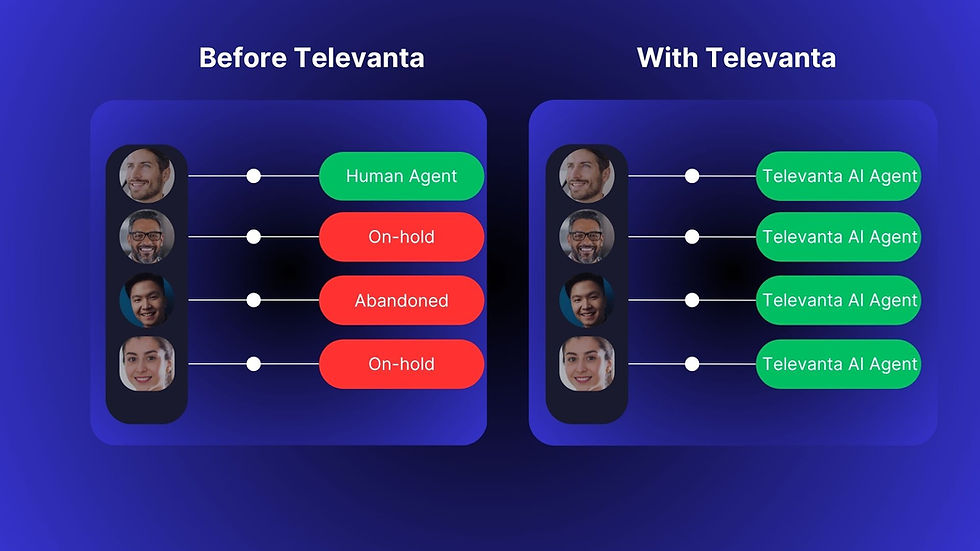
The volume problem is real. In most contact centres, a significant portion of inbound calls are routine. Callers want to know their account balance, confirm an appointment, check on a delivery, or find out what documents they need to bring.
Estas llamadas no son difíciles. Simplemente son muchas. Cuando los agentes humanos dedican la mayor parte de su tiempo a llamadas que no requieren criterio humano, toda la operación se vuelve ineficaz y costosa. Los agentes de voz con IA se encargan de gestionar ese volumen para que los agentes humanos puedan centrarse en situaciones que realmente requieren empatía, experiencia o autoridad.
Coverage without headcount. A human team goes home. An AI voice agent does not. Businesses that handle calls from different time zones, or that simply want to be available outside of business hours, have traditionally had two options: pay for night-shift staff, or let callers go to voicemail and lose them.
AI voice agents offer a third option. They provide full coverage around the clock without any increase in staffing costs.
Consistency and accuracy. Human agents, however talented, have bad days. They mishear things. They misremember policies. They handle calls differently depending on the time of day or how many calls they have already taken.
An AI voice agent follows the same logic on every single call. It accesses the same data. It applies the same rules. For businesses where consistency matters, whether for regulatory compliance, brand standards, or just customer fairness, that reliability has genuine value.
CRM data stays current automatically. After every call, an AI voice agent can produce a complete structured log: the full transcript, the caller's details, the outcome, whether the call was escalated, and what was resolved.
That record is written automatically to the CRM, which means agents are not spending time after calls doing manual data entry, and managers are not working from incomplete or inconsistent records.
Speed of response at scale. A human contact centre can handle as many simultaneous calls as it has available agents. An AI voice agent platform can handle thousands of concurrent calls without any additional setup.
For businesses that experience seasonal spikes, campaign-driven surges, or unpredictable demand, that kind of elasticity is genuinely difficult to achieve with a human workforce.
¿Qué caracteriza a una buena plataforma de agentes de voz con IA?
No todas las plataformas de asistentes de voz con IA son iguales. La calidad de la experiencia depende en gran medida de la calidad de los componentes subyacentes y de lo bien que estén integrados.
The speech recognition engine matters. A poor transcription means the AI misunderstands what the caller said, and the conversation falls apart.
The best platforms give businesses the choice of which speech provider to use and allow that choice to be made on a per-language or per-use-case basis.
El modelo de lenguaje (LLM) que genera las respuestas es fundamental. La IA debe producir respuestas que sean naturales, precisas y adecuadas al contexto. Debe gestionar la ambigüedad con soltura y saber cuándo no dispone de información suficiente para dar una respuesta con seguridad.
The integration with existing systems matters. An AI voice agent that cannot access live data is limited to answering only the questions it was pre-programmed to handle.
The ability to query a live database mid-call is what separates genuinely useful AI voice agents from sophisticated but ultimately hollow scripts.
Y el traspaso a los agentes humanos es fundamental. Una experiencia de derivación mal diseñada, en la que la persona que llama tiene que repetir todo lo que acaba de decirle a la IA, o en la que se corta la llamada durante el traspaso, socava la confianza que la IA se ha ganado a lo largo de toda la conversación.
El enfoque de Televanta respecto a los agentes de voz con IA
Televanta, is built specifically to address the needs of businesses and telecoms that want to deploy AI voice agents at a professional level.
The platform handles inbound calls through SIP trunks or existing Session Border Controllers, which means businesses can connect Televanta to their current telephony setup without replacing anything.
Todas las llamadas gestionadas por Televanta siguen el ciclo completo descrito anteriormente: transcripción en tiempo real, consultas en la base de datos en directo durante la llamada, respuestas generadas por modelos de lenguaje grande (LLM), síntesis de voz natural y enrutamiento inteligente basado en reglas de escalado configurables. El ciclo completo suele completarse en menos de dos segundos.
La plataforma es compatible con múltiples proveedores de tecnología de voz, entre los que se incluyen Deepgram, Azure, Whisper, ElevenLabs y SeamlessM4T, así como con múltiples proveedores de modelos de lenguaje grande (LLM), como OpenAI, Claude y Ollama. Las empresas pueden elegir la combinación que mejor se adapte a su caso de uso, sus requisitos lingüísticos y su infraestructura existente.
For businesses serving multilingual customers, Televanta handles language selection at the individual phone number level.
English, Spanish, German and other languages supported by the chosen speech provider can be set independently, which means a business operating across multiple markets does not have to compromise on voice quality in any of them.
Each phone number in the Televanta platform maps to its own agent configuration, with its own system prompt, escalation rules, and CRM integration settings.
Management happens through a web portal rather than config files, which makes the system accessible to operations teams without requiring developer involvement for day-to-day changes.
For contact centres and enterprises already running a SBC, Televanta works as an AI layer that receives forwarded calls without displacing any existing infrastructure.
The SBC stays in control of routing and signalling, and Televanta simply handles the calls that are sent its way.
That means enterprises can adopt AI voice capabilities incrementally, starting with specific call flows or queues before expanding further.
Una visión realista del lugar que ocupan los asistentes de voz con IA
AI voice agents are not a replacement for human judgment in situations that require it.
Difficult disputes, sensitive conversations, complex technical support, and cases where a caller is distressed or confused all benefit from a human who can read the full emotional context of a situation.
What AI voice agents are is an extremely capable first line. They handle the volume. They qualify callers.
They collect information. They handle calls that do not require a human. And when something does need a person, they route it instantly to the right one, with a full record of the conversation already attached.
The businesses getting the most out of AI voice agents are the ones that have carefully considered which parts of their call flow genuinely require a human and which simply waste human time.
Once that line is drawn, deploying an AI voice agent on the routine side of it tends to deliver results quickly.
If you are evaluating whether AI voice agents are right for your operation, the technical barriers are lower than they were even two years ago.
Platforms like Televanta connect to existing telephony without infrastructure changes, integrate with existing CRM systems, and can be configured without deep technical expertise. The question is less often "can we do this" and more often "where do we start."
Es un buen problema.