Running a call center comes down to three numbers that keep getting worse: labor cost, agent turnover and wait time. Labor can make up as much as 95% of total cost, and US in-house support reps now average $19.74 an hour, about 5% more than a year earlier. Agent turnover runs 30% to 45% a year, and each agent you replace costs an estimated $10,000 to $15,000 to recruit and train.
Customers feel it too. ContactBabel's 2026 research finds US callers now wait 74 seconds on average to reach someone. Much of what they call about is repetitive: order status, password resets, appointment changes, balance checks. You staff for peaks that last an hour, pay for idle seats the rest of the day, and still miss calls after hours. Your best agents spend their shifts on work that doesn't need them, and that's a big reason they leave.
AI call centers change that math. An AI voice agent answers on the first ring, understands what the caller wants in plain speech, does the work inside your systems, and hands the call to a human whenever it should.
This guide is written for call center owners and operators. It walks through how an AI call center actually works, from the IVR at the front door to the dedicated AI agent that resolves the call, and what it means for your costs compared with a human-only team.
What is an AI call center?
An AI call center is a contact operation where AI voice agents answer, understand and resolve calls in natural conversation, and human agents handle the calls that need judgment, empathy or authority. The AI isn't a bolt-on chatbot. It sits on the phone line itself and does the work a tier-1 agent would do, as we explain in how AI call agents work at enterprise scale.
That's different from the automation most callers know. A classic IVR asks callers to "press 2 for billing" and then drops them in a queue. A modern AI call center lets the caller say what they need in their own words, then sends them to an AI agent that can actually finish the job: look up the order, change the booking, take the payment, log the ticket.
The practical result for an owner is simple. Routine calls stop consuming paid human minutes, and your people spend their shifts on the conversations that keep customers.
Under the hood, most AI call centers share four parts. Telephony connects your existing numbers, SIP trunks or cloud contact center. An intelligent IVR greets callers and works out what they need. Dedicated AI agents, each a specialist in billing, scheduling, order status or tech support, resolve the request. And your human team stays on hand as the escalation path, reachable at any point in the call.
How AI call centers work: from IVR to dedicated AI agent
Every call follows the same path: an AI-powered IVR works out what the caller needs, transfers them to a dedicated AI agent built for that job, and keeps a human one step away the whole time.
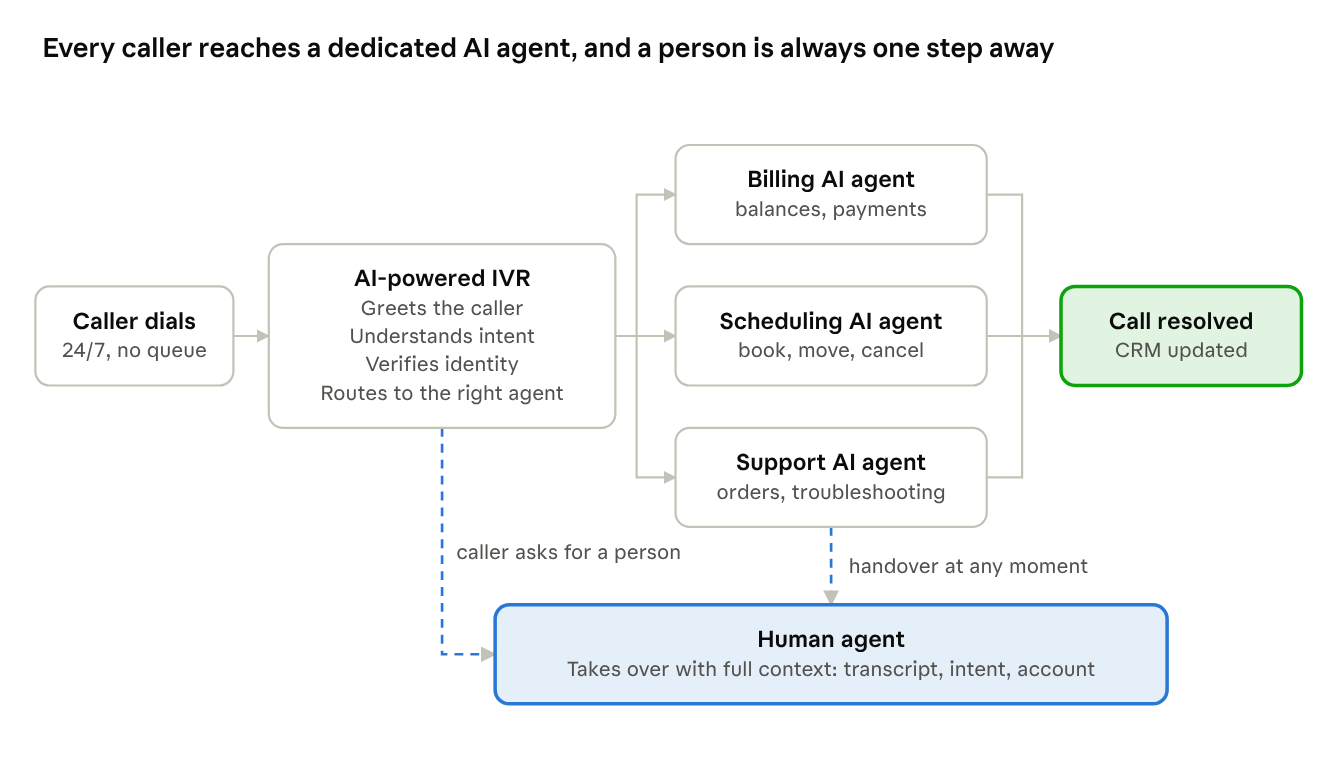
The dashed lines are the part most owners care about: a caller can reach a person from the IVR or from any AI agent, and the person picks up with the full story.
It starts with the numbers you already have. A platform like Televanta's AI call agent connects to any SIP carrier or existing phone number, so there's no porting and no new phone system to buy.
The AI-powered IVR answers first. The caller can say what they need in their own words or use a familiar "press 1 for bookings, press 2 for billing" menu. Either way, the IVR identifies the intent, such as "I was charged twice," verifies identity with an account number, date of birth or one-time code, and captures details like the order number. Our guide to AI IVR and how it replaces "Press 1" menus walks through a real example.
Then the call transfers to a dedicated AI agent, and this is what separates a good AI call center from a glorified chatbot. Instead of one giant bot that tries to do everything, the IVR hands the caller to a specialist: a billing agent, a scheduling agent, an order-status agent or a technical support agent. Each has its own instructions, its own knowledge base and only the system permissions its job needs. The details captured at the front door travel with the call, so nobody has to repeat themselves.
Finally, the AI agent resolves the call and wraps it up. It pulls the account, explains the duplicate charge, issues the refund within the limits you set, confirms by text or email and says goodbye. Then it writes a call summary, tags the reason, updates the CRM and opens a ticket if follow-up is needed. That's after-call work your team no longer does by hand.
Why dedicated agents instead of one do-it-all bot? Specialists are easier to test, safer to give system access to, and far more accurate, because each one only has to be excellent at a narrow set of tasks. It mirrors how you already organize human teams into skills-based queues.
Inside the AI call agent: how it listens, thinks and acts
An AI call agent is a voice-based worker you configure once: a role, a knowledge base, a set of actions it is allowed to take, and rules for when to step aside. On every turn of the conversation it runs the same four-step loop.
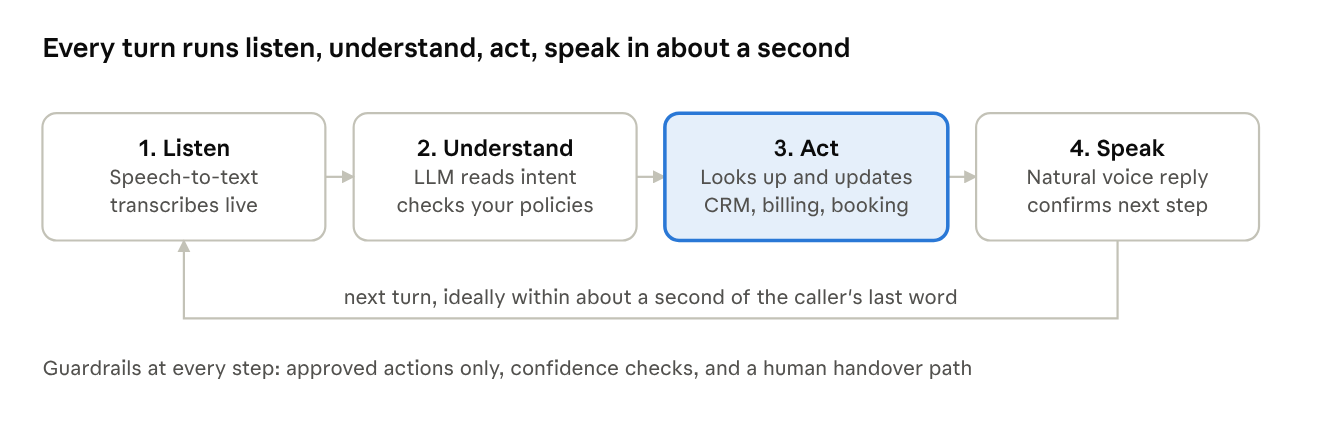
The "Act" step is what makes it an agent rather than an answering machine: it changes things in your systems, within limits you set.
First, the agent listens. Speech-to-text transcribes the caller as they speak, coping with accents, background noise and interruptions, and good agents support barge-in so a caller can cut in mid-sentence the way they would with a person. Next, it understands. A large language model reads the transcript together with the agent's instructions, your knowledge base and the caller's account data, and works out what the caller actually wants, even when they ramble or change topic.
Then it acts through integrations: checking an order, rebooking an appointment in your calendar, taking a payment through a compliant processor or opening a ticket in your helpdesk, using only the permissions its job needs. Last, it speaks. Text-to-speech replies in a natural, on-brand voice, and the loop starts again on the next turn.
Speed is what makes this feel human. People expect a reply within about half a second, and pauses longer than a second start to feel unnatural. A practical target for production agents is roughly 600 to 1,200 milliseconds from the caller's last word to the agent's first. Ask any vendor to demo on a real phone line, not a browser, because the phone network adds its own delay.
As the owner, you stay in control of every agent. You define what a successful call looks like, keep its knowledge (policies, FAQs, product details) in one place, and set limits on what it can do, such as refunds up to $50 without approval. You choose its voice and tone, and you write the escalation rules that send certain topics, emotions or customers straight to a person. When a policy changes, you update the document and the agent's answers change with it, as our telecom AI call agent walkthrough shows.
Human handover, at any moment
A well-built AI call center never traps a caller. At any point, from the first greeting to the last confirmation, the call can move to a person, and that person picks up already knowing what happened.
This isn't only good manners; it's what makes customers willing to use AI in the first place. In a Gartner survey of 3,566 customers published in August 2026, 87% said companies using generative AI for service must offer a way to reach a human. A Five9 consumer study found trust in AI to resolve an issue rises from 26% to 55% when people know a clear human option exists. The human exit makes the AI more accepted.
Handover can be triggered in several ways:
- The caller asks. "Can I talk to someone?" always works, with no hoops to jump through.
- The AI isn't confident. If it can't identify the intent or answer with confidence, it escalates instead of guessing.
- Emotion runs high. Sentiment detection flags anger, distress or confusion and routes to a person.
- The request is outside policy. A refund above your limit, a contract exception, a retention offer that needs approval.
- Your rules say so. High-value accounts, vulnerable customers, legal or medical topics, or any keyword you choose.
What matters is how the transfer happens. A good system does a warm transfer: the human agent sees the transcript, the detected intent, the verified identity and a one-line summary before they say hello. The caller never hears "Can you start from the beginning?" If no one is free, the AI can book a callback at a time that suits the caller rather than parking them in a queue.
For owners, this flips the staffing model. Your human team stops being the first line for every call and becomes the expert line for the calls that need them.
The cost case for AI call centers
For owners, the real cost question is how much human handling cost an AI call center takes off your books. The answer depends on your call mix: the more routine calls you handle, the bigger the saving.
Where your money goes today
A fully loaded human-handled call costs about $4 to $8 in-house in the US, and $3 to $8 through a BPO, according to Open.cx's 2026 cost analysis. ContactBabel puts the average US inbound call at $7.20. Labor makes up most of that, and it brings costs that never appear on a per-call report.
With 30% to 45% of agents leaving each year, you keep paying $10,000 to $15,000 per replacement, plus weeks of onboarding before a new hire works alone. You staff seats for peaks that last an hour, pay overtime or overflow contracts when volume spikes, and every call still ends with notes and tickets written by hand.
What changes with AI agents
AI agents remove most of those costs for the calls they handle. Routine calls are resolved without a paid human minute. Spikes are absorbed because the AI answers many calls at once, so you don't hire for the peak. Summaries, tags and CRM updates are written automatically. Nights and weekends are covered without extra shifts.
A worked example: 10,000 calls a month
Take a center handling 10,000 calls a month at $6 per human-handled call, the middle of the in-house range. If AI agents fully resolve 60% of calls, which is conservative against the 65% to 77% that well-tuned deployments target, here is how human handling cost moves:
| Human only | AI first, human handover | |
|---|---|---|
| Calls resolved by AI | 0 | 6,000 |
| Calls handled by people | 10,000 | 4,000 |
| Human handling cost at $6 per call | $60,000 | $24,000 |
That's $36,000 a month of human handling capacity freed up, before counting what you save on hiring, training and turnover. Your team doesn't shrink overnight; it stops spending its day on calls a machine can finish.
To run these numbers on your own call mix, book a 20-minute demo and see an AI agent answer a live call on your number. Once you're live, judge success by resolution rate, repeat contacts, transfer quality and CSAT on AI-handled calls, the metrics we cover in our guide to the top 10 AI voice agents for contact centers.
Benefits of AI agents over human-only answering
The biggest benefit of AI call centers isn't replacing people. It's that every caller gets an instant, consistent answer, while your people spend their time where it counts.
| Human-only call center | AI call center with human handover | |
|---|---|---|
| Availability | Business hours, or costly night shifts | 24/7, including holidays |
| Time to answer | Depends on queue and staffing | First ring |
| Volume spikes | Hold times climb, calls abandoned | Many calls answered at once |
| Languages | Limited to who is on shift | Dozens of languages on every call |
| Consistency | Varies by agent, mood and tenure | Same policy and tone every time |
| New process or policy | Retrain the whole team | Update the agent's instructions once |
| After-call work | Written by hand | Summary, tags and CRM update automatic |
| Turnover risk | 30% to 45% of agents leave each year | Knowledge stays in the system |
No more missed calls. Every unanswered call is a lost sale, a cancelled booking or a customer who tries a competitor. AI agents pick up on the first ring at 3 p.m. or 3 a.m., and the queue disappears for routine requests.
Peaks stop being a crisis. A billing run, a product recall or a storm can triple call volume in an hour. Instead of overtime and overflow contracts, AI agents absorb the spike, as airlines do when disruption hits; see how it works in our AI agents for airlines page.
Consistent, compliant answers. An AI agent never improvises a refund policy or forgets a disclosure. Every call is transcribed, so quality assurance covers 100% of calls instead of a small sample.
Every caller in their own language. Multilingual AI agents switch languages without a separate team. Televanta agents speak 30+ languages, which matters for operators like the ones on our AI call agent for telecom page, where subscribers call in many languages.
Outbound work at scale. The same agents can call customers too: reminders, confirmations and follow-ups. Our post on the appointment confirmation AI agent shows how this cuts no-shows for hospitals.
Better jobs for your people. When the repetitive calls go to AI, human agents handle the interesting and meaningful ones. That's less burnout, and less of the churn that drives up hiring and training costs.
Insight from every conversation. Because every call is tagged by reason, you see why customers call and can fix root causes, such as a confusing invoice that drives thousands of calls a month.
Where humans still win, and how to roll out
AI call centers work best when you're honest about what AI should and shouldn't do. The goal is a split: AI agents finish the routine calls, and your people own the conversations where judgment, empathy or authority matter.
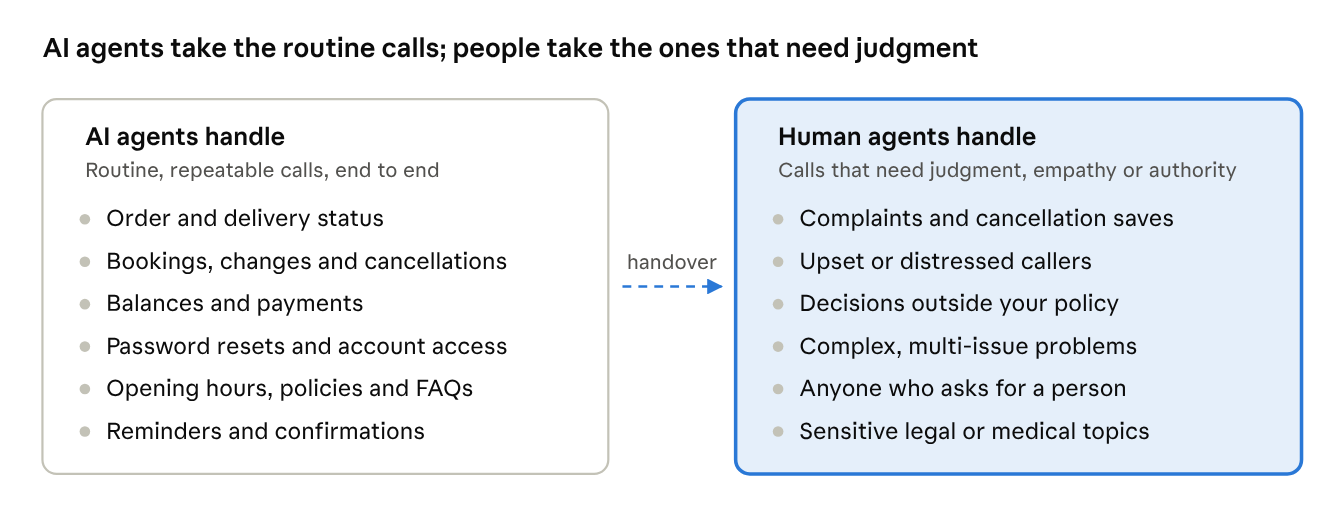
The right column is where your experienced agents add the most value, and it's where you want them spending their shifts.
A practical rollout starts small. Pull your call reason data and pick two or three high-volume, low-risk call types, such as order status, appointment changes or balance checks. Build a dedicated agent for each, with its knowledge, system connections, limits and escalation rules, then test it against recorded calls and internal test calls until the answers and transfers are solid.
Next, go live on a slice of traffic. After-hours calls or overflow are a safe place to start, while your team handles everything else as usual. Read transcripts every week, fix the gaps, and add the next set of call types once the first ones run smoothly.
This doesn't need to be a long IT project. Televanta agents typically go live in days, not months, on the numbers you already have.
AI call center FAQ
What is an AI call center?
It's a call center where AI voice agents answer and resolve calls in natural conversation, and human agents take over when a call needs a person. Callers speak normally instead of pressing through menus.
Can callers reach a human at any time?
Yes, and they should be able to. In a well-built AI call center, a caller can ask for a person or press 0 at any point. The AI also transfers automatically for complaints, sensitive topics or anything outside its limits, passing along the full conversation.
Will callers know they're talking to AI?
They should. Being upfront builds trust, and in many regions, including the EU, rules require telling people when they're interacting with an AI system. A short line in the greeting is enough.
Do I need to replace my phone system or IVR?
No. AI agents connect to your existing numbers through SIP or your current cloud contact center. You can keep a familiar keypad menu and put a dedicated AI agent behind each option.
How many calls can AI agents resolve?
It depends on your industry and call mix. Well-tuned deployments target 65% to 77% front-line resolution for routine calls. Regulated fields like financial services and healthcare usually land lower, because more calls need a person.
How long does it take to launch?
With a platform built for call centers, days rather than months. Most of the time goes into choosing call types, connecting systems and testing, not building technology.
What languages can AI agents speak?
Modern voice agents handle many languages on the same line. Televanta supports 30+ languages with native-quality voices.
Is customer data safe?
It should be a top question for any vendor. Ask where calls are processed and stored, how long data is kept, and how access is controlled. Televanta was built to be privacy-focused from the start.
Bringing AI into your call center
AI call centers aren't about taking people out of customer service. They're about putting each call in the right hands: an AI agent for the routine request that should take two minutes, and a person for the call that needs care.
The model is simple. An AI-powered IVR understands the caller, a dedicated AI agent resolves the request, and a human is one step away the whole time. You answer every call, absorb spikes without overtime, and stop spending skilled human time on repetitive work.
If you run a call center and want to see this on your own lines, book a 20-minute Televanta demo. We'll set up a live AI agent on your number, in your language and with your workflow.
Created on
Antonio Lupieri is an agentic AI leader at Televanta, where he helps businesses automate customer communication across phone, chat, WhatsApp and email. On the blog, he writes about AI voice agents, intelligent IVR, chatbots, WhatsApp bots and AI email assistants.